Appliance Repair in Bellflower, CA
Bellflower housing is mostly older stock, with a median build year of 1966. That changes how appliances fail here and how they are replaced, and it is why we diagnose the opening and the circuit along with the machine.
Where we work in Bellflower.
Bellflower is a city of about 75,716 people in Los Angeles County. Dispatch covers 2 delivery ZIP codes here, and the technician who comes out works Los Angeles County every day. One technician group covers all of Bellflower; the ZIP codes below are the delivery areas we serve.
Not sure if we reach you?
Tell us the cross street. We will tell you the time window in about ten seconds.
Every major appliance, freestanding or built in.
Refrigerator & freezer
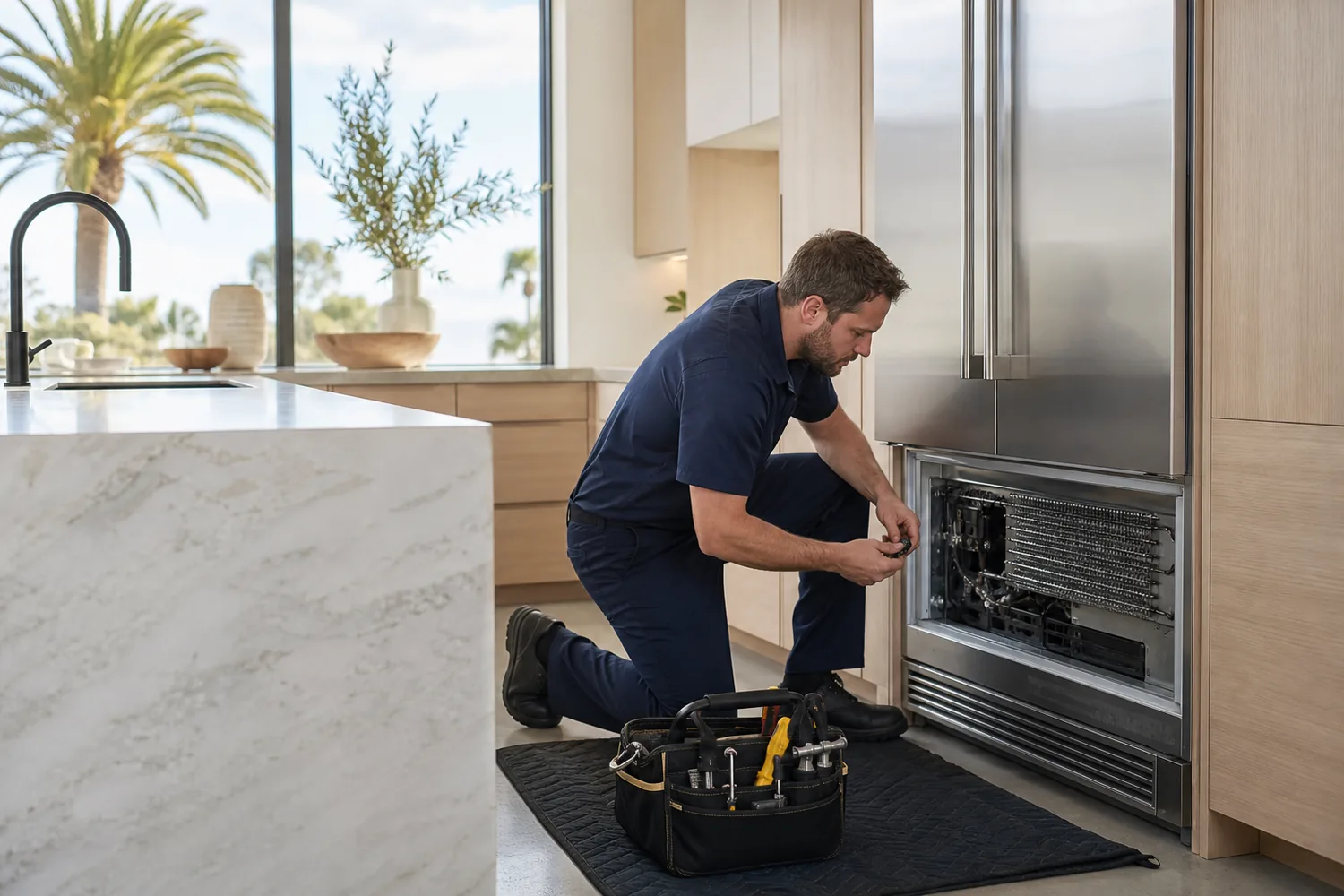
Not cooling, leaking, loud compressor, warm freezer. Freestanding, counter depth and built-in columns.
Washer
Will not spin, will not drain, leaking or walking. Front load, top load and stacked.
Dryer
No heat, endless cycles, thermal shutdown. Half the calls in older stock are the vent run, not the dryer.
Dishwasher
Not draining, not cleaning, leaking, stuck mid cycle. Panel-ready and integrated units included.
Oven, range & cooktop
Burners that will not light, uneven baking, dead board. Gas, electric, induction and dual fuel.
Ice maker
No ice, slow ice, small hollow cubes, flooded bin. Under counter and built-in units too.
Microwave & disposal
Built-in, drawer and over-range microwaves, jammed disposals, vent hoods and warming drawers.
SPECIALISTBuilt-in & luxury
Sub-Zero, Viking, Thermador, Wolf, Miele and Dacor. Assigned to a technician who has worked the platform.
What Bellflower repairs actually cost.
Nobody else on this search result will show you a number before you call. Here is the honest range, and what moves it.
| Typical Bellflower job | What usually causes it | Typical range |
|---|---|---|
| Dishwasher not draining or not cleaning | A blocked sump, a tired drain pump or a failed inlet valve | $150 to $400 |
| Ice maker not producing | A failed fill valve, a frozen fill tube or a worn module | $150 to $380 |
| Refrigerator not cooling | Condenser fan, defrost system or a start relay | $180 to $480 |
| Dryer runs but will not heat | Element or thermal fuse, and very often a blocked vent run | $140 to $380 |
| Washer will not drain | Drain pump, filter obstruction or the hose | $160 to $450 |
| Oven not heating evenly | Igniter, bake element or a calibration drift | $160 to $480 |
| Built-in refrigerator sealed system | Refrigerant charge, compressor or evaporator on a built-in | $800 to $2,200 |
One flat diagnostic fee of $89 gets a licensed technician to your door. The full repair is quoted before any work starts, you approve it first, and the diagnostic fee goes toward the job when you book the repair.
What people here ask us first.
Fit and power, before anything mechanical. The median Bellflower home dates to 1966, and 72 percent of the housing stock predates 1980, so a lot of kitchens here were built around appliances that are no longer standard sizes. A replacement that is nominally the same width can still foul the cabinet face, the counter overhang or the door swing. Older circuits are the other half of it. A kitchen wired for the appliances of that era often cannot carry what a modern oven or a heat pump dryer wants, and the symptom is not a dead appliance but an intermittent one that trips under load. Parts availability matters too, since a discontinued board on a well-built older unit can be the difference between a sensible repair and a replacement. We check the opening and the circuit before quoting, because finding out afterwards is how a repair turns into a remodel. It matters more here because about 48.5 percent of homes here are detached single family.
The most expensive thing to fix on a refrigerator is also the most preventable, and the prevention is unglamorous. The compressor fails from heat and overwork, so everything that makes it run hotter or longer shortens its life. Condenser coils matted with dust and pet hair are the biggest single cause; the compressor cannot shed heat through a blanket of lint, so it runs hot every cycle. A condenser fan that has stopped does the same thing faster. A door gasket that no longer seals keeps the machine running to chase warm air. A refrigerator in a garage that hits triple digits in summer works twice as hard as one in a kitchen. And a slow refrigerant leak left for months makes the compressor labor against a system that cannot cool.
The early signals are worth knowing because they arrive before the bill. A compressor that runs almost constantly and is hot to the touch, a freezer that holds but a fresh-food section that creeps warm, frost on one section of the evaporator with the rest bare: those point toward the sealed system and deserve a diagnosis now rather than later. The lookalikes, a failed evaporator fan, a defrost fault, a bad relay, produce similar symptoms at a fraction of the cost, which is why the technician tests those first.
Clean the coils twice a year and keep the fan working, and the expensive repair may never come up. If it has, the diagnostic visit is $89, applied to the repair when you go ahead.
There is no fixed timeline, because scale is a dose. What matters is the hardness of the water multiplied by the gallons that pass through the appliance multiplied by the years, and the temperature the water is heated to, since heat drives the minerals out of solution. A family of five running the dishwasher daily and the washer twice a day in very hard water can scale a fill valve in a couple of years. A single person running each twice a week in moderate water might see nothing for a decade. The same appliance, the same water, a different household, a different answer.
Heat concentrates the effect. The dishwasher heats its water to a high temperature every cycle and it has the narrowest passages, so it scales fastest. The washer, especially on warm and hot cycles, comes next. An ice maker heats nothing, but its passages are tiny and it never stops, so it keeps pace with the dishwasher.
A softener resets the clock to zero. Descaling on a schedule slows it, roughly in proportion to how often you do it. And the damage is in stages: noticeable long before it is fatal. Cloudy glasses and small ice cubes are the early warning; a valve that has scaled shut is the repair. Catch it at the warning stage and the cost is a cleaning. Catch it at the repair stage and the cost is a part, still modest. Miss both and the cost is the diagnosis of a symptom that looks like something else.
We also cover the rest of Los Angeles County.
Appliance down in Bellflower?
One call reaches a licensed technician near you. Same-day slots go fast.