Freezer Repair Across California
A freezer that is not freezing is a clock. Ice cream goes soft in hours, meat thaws in a day, and a chest freezer full of a season of food is a real loss. The good news is that freezers are simple machines and the faults are predictable: the defrost system on a frost-free upright, a cold control or start relay on a chest, a fan that has stopped, a gasket that no longer seals, a condenser packed with garage dust. A technician who sees these every day finds the fault fast and usually carries the part.
We repair chest freezers, upright freezers, the freezer side of any refrigerator, the garage freezer that has to work in summer heat, and the built-in and column freezers that need sealed system skills. Same day in most metros, one flat diagnostic fee, the full price in writing before any work.
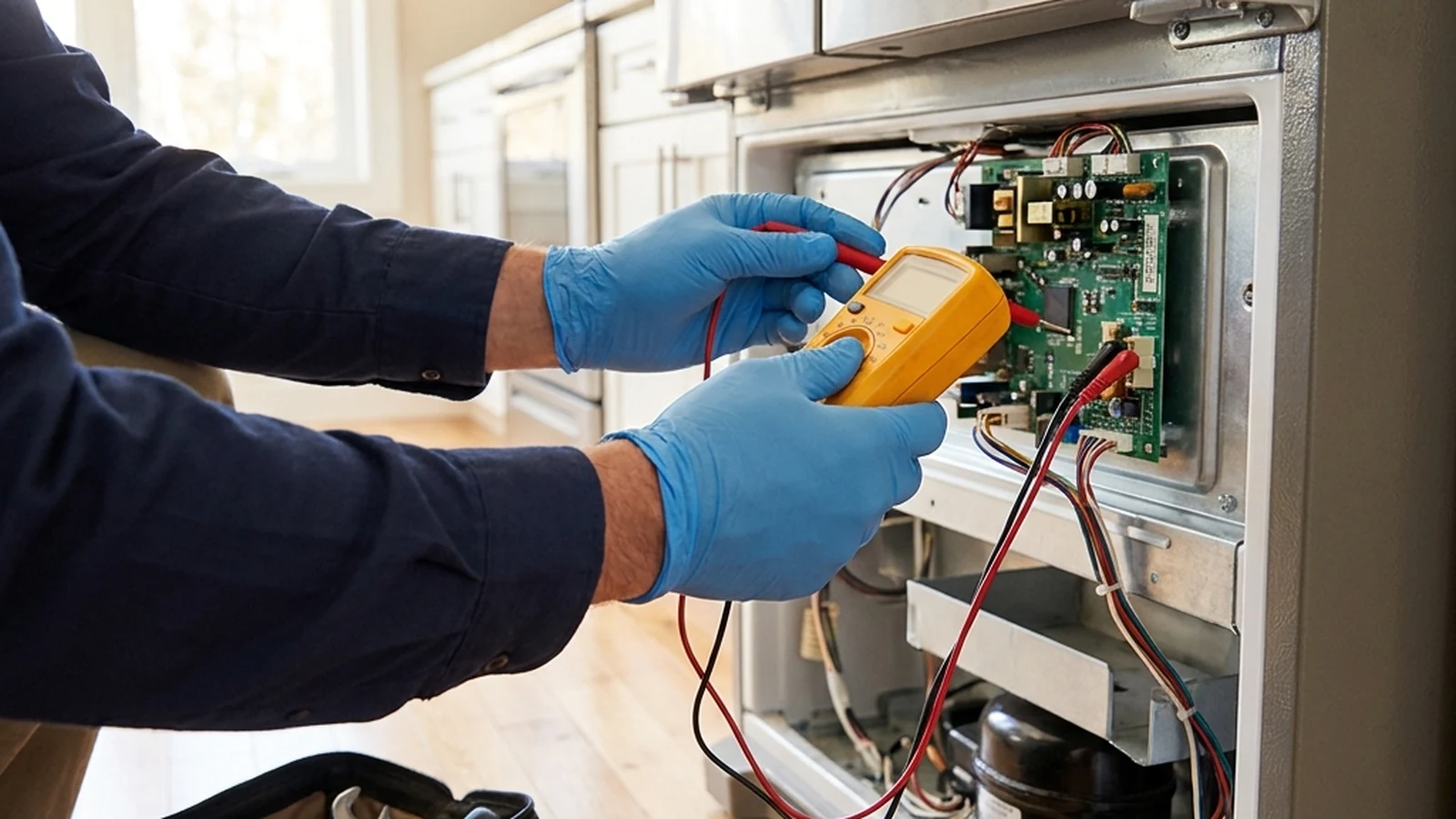
What a failing freezer looks like.
Frost on the back wall, food thawing at the front
On a frost-free freezer, a thick layer of frost on the rear panel means the defrost cycle has stopped running. The defrost heater, the defrost thermostat or the control that times them has failed, the evaporator has iced into a block and the fan can no longer pull air across it. The freezer feels cold but the food is not frozen hard. It is a common repair and a straightforward one.
Runs all the time and never gets cold enough
A freezer that never cycles off is losing cold faster than it makes it. The usual causes are a door gasket that has hardened or torn, a condenser coil coated in dust and pet hair so it cannot shed heat, a condenser fan that has stopped, or a compressor that has lost efficiency with age. Garage freezers in the Central Valley and the Inland Empire do this every summer, and the condenser is where we look first.
Dead, humming or clicking
A chest freezer that is silent with the light on has usually lost its cold control or its start relay. One that hums for a few seconds, clicks and goes quiet is trying to start the compressor and failing, which is the relay or the compressor. Both are quick tests with a meter. A compressor that runs but moves no cold has a sealed system problem, and that is where the repair or replace conversation starts.
What we repair on freezers.
Chest, upright, drawer, garage and built-in, every major brand.
- Cold controls, thermostats, thermistors and electronic controls
- Start relays, overload protectors, run capacitors and compressors
- Defrost heaters, defrost thermostats, defrost timers and control boards
- Evaporator fans, condenser fans and fan motors
- Door gaskets, lid gaskets, hinges, lid supports and closers
- Condenser cleaning and airflow repairs on garage units
- Ice makers in freezer drawers and column freezers
- Sealed systems on built-in and column freezers: leaks, evaporators, condensers, compressors
What freezer repair costs in California.
| Typical job | What usually causes it | Typical range |
|---|---|---|
| Freezer not freezing | Defrost system, evaporator fan or a start relay | $160 to $420 |
| Frost building on the back wall | Failed defrost heater, thermostat or control | $160 to $420 |
| Runs constantly, never cold enough | Door gasket, dirty condenser or a weak compressor | $160 to $420 |
| Chest freezer dead | Cold control, start relay or the compressor | $160 to $420 |
| Sealed system on a built-in freezer | Refrigerant leak, compressor or evaporator | $800 to $2,200 |
The diagnostic visit is $89. The whole repair is quoted in writing before any work, you approve it first, and the fee is credited to the job when you go ahead.
A typical freezer repair, such as a defrost component, a cold control, a start relay, a fan or a gasket, lands between $160 and $420 for parts and labor after the diagnostic fee is applied. Sealed system work on a built-in freezer, which means finding a refrigerant leak and replacing an evaporator, a condenser or a compressor, runs between $800 and $2,200.
The diagnostic visit is $89, credited to the repair when you go ahead. You get the complete price in writing before any work starts, and if the answer is that the freezer is not worth fixing, you get that in writing too.
Repair it, or replace it?
Chest freezers are the most repairable appliance in the house. There is very little in them, the parts are inexpensive, and a well made chest freezer runs fifteen to twenty years. A cold control, a relay or a gasket on a chest freezer of any age is a repair. Upright frost-free freezers have more to go wrong, but a defrost fault or a fan on a unit under twelve years is still a clear repair.
Replacement makes sense when a freestanding freezer past twelve years has a sealed system fault, or when a budget upright has two or three failures at once. Built-in and column freezers are a different calculation: the replacement cost includes cabinetry and panels, so a sealed system repair on a fifteen year old built-in is usually the better number. You will see both numbers before you decide.
What people ask before they call.
On a refrigerator with a single compressor the freezer is where the cold is made, so a freezer that has gone soft while the fresh food side stays cold is telling you something specific. The cold is being produced, and it is being pulled away from the freezer compartment faster than it can build. The usual reasons are a freezer door or drawer that is not sealing, a gasket that has torn or hardened, a drawer overfilled so it never quite closes, or a damper stuck open sending too much of the cold to the fresh food side.
The other possibility is a freezer that is frosting rather than freezing. When the defrost heater, thermostat or control fails, ice builds on the evaporator coil until the fan cannot move air through it. The compartment holds a cold that feels right to the hand, and ice cream goes soft anyway because the air is not circulating. Heavy frost on the back panel of the freezer is the giveaway.
Less often it is a fan that has stopped in the freezer, a thermistor giving the control a wrong reading, or on a dual evaporator refrigerator the freezer side of the sealed system losing its charge. A technician separates these on the first visit. Check the gasket with a sheet of paper, clear the drawer so it closes fully, and if that does not bring the freezer back overnight, call (888) 482-7007.
Freezers are among the cheapest appliances to repair because there is so little inside them. A chest freezer has a cold control, a start relay, a compressor and a lid gasket. An upright frost-free freezer adds a defrost heater, a defrost thermostat, a control and an evaporator fan. The parts that fail are the small ones, and a typical freezer repair, such as a cold control, a relay, a defrost component, a fan or a gasket, lands between $160 and $420 for parts and labor after the diagnostic fee is applied.
The part that is not cheap is the compressor, and on a freestanding freezer we are honest about it: on a budget chest freezer a compressor replacement approaches the price of a new freezer, and we will say so. On a built-in or column freezer, sealed system work including a compressor runs between $800 and $2,200, and it is nearly always the right call because of what replacing a built-in involves.
The diagnostic visit is $89, credited to the repair when you go ahead. You get the full repair price in writing before any work begins, and the number you approve is the number on the invoice. There is no hourly rate, and a return trip to fit a part we had to order is inside the quote.
A chest freezer is the most repairable appliance in most homes. There is almost nothing to it, the parts are inexpensive, and a decent chest freezer runs fifteen to twenty years. A cold control, a start relay or a lid gasket is a repair on a chest freezer of any age. The one fault that changes the answer is a failed compressor or a refrigerant leak on a small budget chest, where the repair price meets the replacement price.
An upright frost-free freezer is closer to a refrigerator in what can go wrong. The defrost system, the evaporator fan and the control board fail more often than the compressor, and each of those is a clear repair on a freezer under twelve years old. Past that, an upright with a sealed system fault is usually replaced, and one with a defrost fault is usually still repaired.
The other thing that counts is what is in it. A full chest freezer of a season's harvest, a side of beef or a month of prepared meals is worth more than the freezer, and a repair that saves the contents is a good deal even on an old unit. Keep the lid closed, call (888) 482-7007, and tell us chest or upright and what it is doing. We can usually tell you on the phone whether the visit makes sense.
Chest freezers run longer than almost any other appliance, fifteen to twenty years being typical, because the design is simple and the lid seal is helped by gravity. Upright frost-free freezers, with their defrost systems, fans and electronics, run ten to fifteen. The freezer compartment of a refrigerator lasts as long as the refrigerator, which is ten to fifteen for a freestanding unit and twenty for a built-in.
The main thing that shortens a freezer's life in California is where it lives. A garage or a side yard shed in the Central Valley, the Inland Empire or the high desert puts the freezer in a room that can pass a hundred degrees for weeks, and the compressor runs long hours to hold zero against it. A condenser coated in garage dust makes that worse. Clearing space around the unit and cleaning the condenser once a year is the cheapest life extension there is.
The other is the door. A lid or door gasket that has hardened lets warm moist air in constantly, the compressor runs to compensate, and on a frost-free unit the extra moisture overloads the defrost system. Replacing a gasket that no longer holds a sheet of paper is a small repair that protects the expensive part. A freezer inside its expected life with one fault is a repair; one well past it with a compressor fault is a replacement, and we tell you which is which.
Keep it closed. A full freezer that is not opened holds its temperature for about forty eight hours, and a half-full one for about a day, which is more time than most repairs need. Every time the lid or door is opened, cold air falls out and the clock speeds up. If you must open it, do it once, take out what you need for the next two days, and shut it. Do not add warm food, and do not put a bag of ice on top of the contents, because the water it becomes goes everywhere.
If the freezer is fully off and the repair is more than a day away, dry ice is the answer for a chest freezer. A block placed on cardboard on top of the food, with the lid closed and the room ventilated, holds a full chest for a further two days. For a small amount of food, a neighbor's freezer or a cooler with ice packs is simpler.
When the freezer is running again, check the food rather than the freezer. Anything that still has ice crystals in it or feels refrigerator cold can be refrozen. Meat and fish that has fully thawed and warmed should not be. Ice cream and soft foods that have thawed will not come back the same. Call (888) 482-7007 as soon as you notice the freezer is warming; freezer calls go early in the day for exactly this reason.
Every region of California, one number.
Nine dispatch regions and 217 city pages. The technician who comes out works the area you live in.
The luxury platforms we repair for this job.
Assigned to a technician who has worked the platform, with the factory service literature open.
Freezer warming up? Call before the food does.
Keep the lid or door shut, do not add warm food, and call (888) 482-7007. A full chest freezer holds its temperature for roughly two days closed, which is more time than most repairs need.