Wine Cooler and Wine Refrigerator Repair Across California
A wine cooler is a small refrigerator asked to hold a narrow temperature in a warm room, and it fails the way a refrigerator does: a thermostat or a control board that has lost the plot, a fan that has stopped moving air across the coil, a door seal that has hardened, a condenser packed with dust, or on the thermoelectric models a Peltier module or its fan. A collection that has been sitting at sixty five degrees for a week deserves a technician who can tell those apart in one visit.
We repair compressor and thermoelectric wine coolers, single and dual zone, under-counter and built-in wine refrigerators, the full-height wine columns in luxury kitchens and the beverage centers that share the same parts, from every major brand. One flat diagnostic fee, the full price in writing before any work.
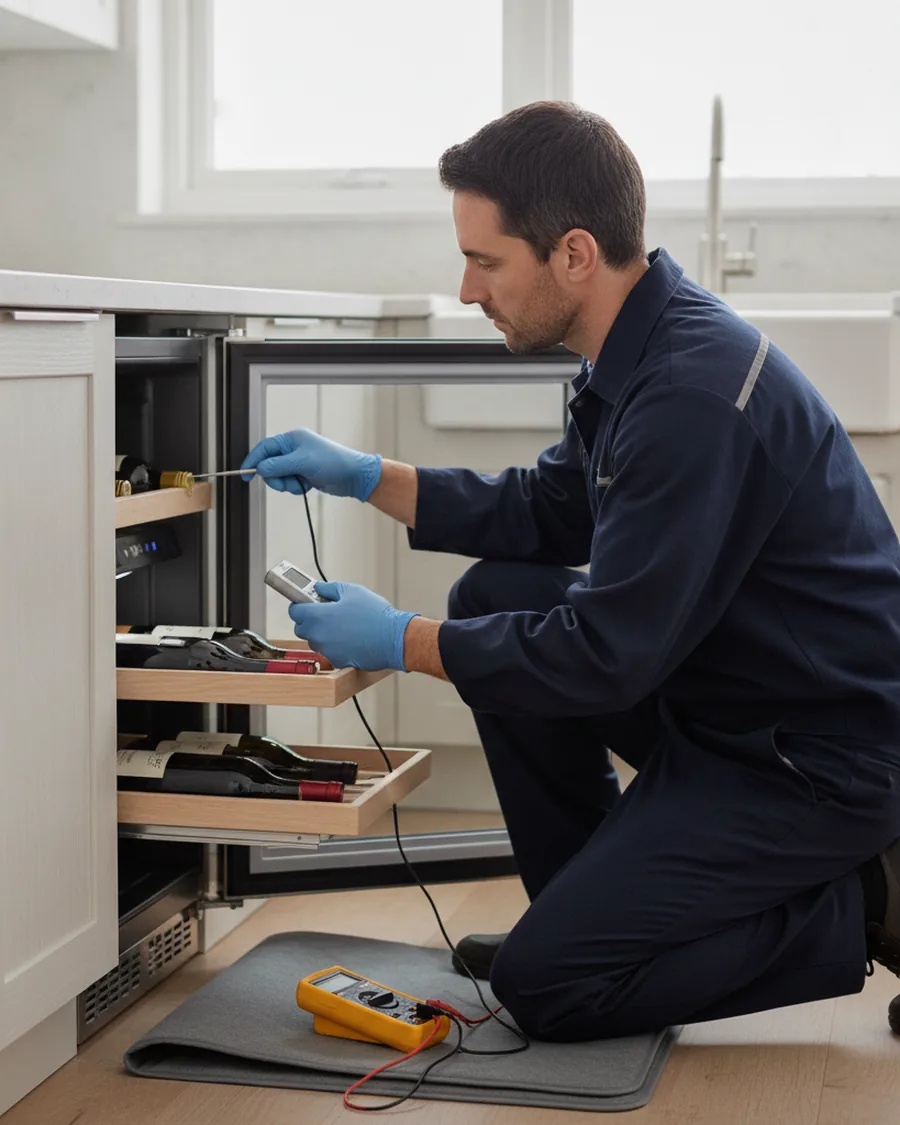
What a wine cooler is telling you.
Set to fifty five, reading sixty five
A compressor unit that runs but cannot reach its set point has a fan that has stopped, a condenser it cannot breathe through, a door seal letting warm air in, or a thermostat and board that are no longer switching the compressor on when they should. A unit in a garage or against a west-facing wall in the Inland Empire will also lose ground in summer simply because the room is hotter than the cooler was designed for.
Thermoelectric unit warm, fan running or not
Thermoelectric coolers have no compressor. A Peltier module moves heat from the inside to a heat sink, and two fans move air across each side. When the interior fan stops, the module ices and the cabinet warms. When the exterior fan stops, the module overheats and fails. A power supply that has dropped its voltage produces a cooler that is only slightly cool. These are inexpensive parts on a good cabinet and expensive ones on a cheap countertop unit.
Noisy, vibrating, or cycling on and off
A rattle is usually a fan with a worn bearing or a loose grille, and a vibration is a compressor mount or a unit that is not level and is passing vibration into the cabinetry. Short cycling, where the compressor starts and stops every couple of minutes, is a start relay, a thermostat fault or a sealed system that has lost part of its charge. Vibration matters more in a wine cooler than in a refrigerator, because it disturbs the sediment in the bottles.
What we repair on wine coolers.
Compressor and thermoelectric units, under-counter, built-in and full-height columns.
- Thermostats, thermistors, control boards and displays
- Evaporator fans, condenser fans, circulation fans and fan motors
- Compressors, start relays, overload protectors and capacitors
- Peltier modules, heat sinks, fans and power supplies on thermoelectric units
- Door gaskets, hinges, door closers and glass door assemblies
- Condenser cleaning and airflow repairs on built-in and garage units
- Interior lighting, humidity trays and shelf hardware
- Sealed systems on compressor units: leaks, evaporators, condensers and compressors
What wine cooler repair costs in California.
| Typical job | What usually causes it | Typical range |
|---|---|---|
| Not holding temperature | Thermostat, control board or a fan | $180 to $480 |
| Runs constantly | Door seal, dusty condenser or garage heat | $180 to $480 |
| Thermoelectric unit warm | Peltier module, fan or a power supply | $180 to $480 |
| Noisy or vibrating | Fan bearing, compressor mount or leveling | $180 to $480 |
| Compressor unit sealed system | Refrigerant leak or a compressor | $800 to $2,200 |
The diagnostic visit is $89. The whole repair is quoted in writing before any work, you approve it first, and the fee is credited to the job when you go ahead.
A typical wine cooler repair, such as a thermostat, a control board, a fan, a start relay, a Peltier module or a door gasket, lands between $180 and $480 for parts and labor after the diagnostic fee is applied. That is our refrigerator range, because a wine cooler is a refrigerator with a narrower job and the same class of parts. Sealed system work on a compressor unit runs between $800 and $2,200.
The diagnostic visit is $89, credited to the repair when you go ahead. You see the whole price in writing before anything is done, and a return trip to fit an ordered part is inside the quote.
Repair it, or replace it?
A built-in or under-counter wine refrigerator is a repair well past ten years, because it sits in a cabinet opening, often behind a panel, and replacing it means a matching unit and an installer. A full-height wine column in a luxury kitchen is a repair at any age for the same reason. Fans, thermostats, boards and gaskets are small money on those cabinets.
Replacement is the honest answer for a thermoelectric countertop unit, where the Peltier module and fans cost close to a new unit, and for a freestanding compressor cooler past ten years with a sealed system fault. If yours is one of those, you will hear it from us on the phone or in the written quote, not after the repair.
What people ask before they call.
A wine cooler holds temperature by making a little cold and keeping it in, and it loses temperature when either side fails. On a compressor cooler the cold is lost first through the door: a gasket that has hardened or torn, a glass door that no longer closes square on its hinges, or a door opened often in a warm kitchen. Then through the condenser, a coil at the back or under the unit that cannot shed heat once it is packed with dust, or that has lost its fan. Then the control: a thermostat or a board that no longer switches the compressor on at the set point, or a thermistor reading the wrong temperature.
A cooler that runs constantly and still reads warm is fighting the room. A unit in a garage, a pool house or against a west wall in the inland heat is being asked to hold fifty five degrees in a room that is over ninety, and many coolers are only rated to pull thirty degrees below ambient. Moving it or shading it fixes what no part can.
Thermoelectric coolers fail differently. There is no compressor, just a Peltier module and two fans, and when the interior fan stops the module ices and the cabinet warms, and when the exterior fan stops the module overheats and fails. A technician separates all of this in one visit with a thermometer and a meter. Call (888) 482-7007 with the type of cooler and what the display reads against the setting.
A wine cooler is a small refrigerator with a narrower job, and its repairs are priced the way we price refrigerator repairs. A thermostat, a control board, an evaporator or condenser fan, a start relay, a door gasket, a hinge or a Peltier module and its fan each lands between $180 and $480 for parts and labor after the diagnostic fee is applied. A condenser cleaning and a gasket, which together fix a good share of coolers that run constantly, are at the bottom of that range.
The expensive end is the sealed system on a compressor unit: a refrigerant leak found and repaired, a filter drier, an evaporator or a compressor. That runs between $800 and $2,200, and on a freestanding cooler we tell you honestly whether the unit is worth that number. On a built-in wine refrigerator or a full-height wine column it nearly always is.
Every visit begins with a $89 diagnostic, which pays for a licensed technician to find the fault rather than guess, and the fee is credited toward the repair when you go ahead. You get the complete price in writing before any work starts, there is no hourly rate, and a return trip to fit an ordered part is inside the quote. A thermoelectric countertop unit whose module and fans cost close to a new cooler gets that answer on the phone.
It depends on what the cooler is and where it sits, more than on what has failed. A built-in or under-counter wine refrigerator is set into a cabinet opening, often behind a panel, and replacing it means a matching unit and an installer. A full-height wine column in a luxury kitchen is the same case at a larger scale. On those, a thermostat, a board, a fan, a gasket or even a sealed system repair is a fraction of the alternative, and the repair is the right call well past ten years.
A freestanding compressor cooler is a repair while the fault is a control, a fan, a relay or a gasket, and a replacement conversation when the sealed system has failed past ten years. A thermoelectric countertop or small freestanding cooler is where repair rarely makes sense: the Peltier module and the fans are most of the cost of the unit, and a new one is often cheaper than the parts.
The other thing to weigh is what is in it. A collection that is worth many times the cooler is worth a same-day repair on almost any cabinet, because a week at sixty five degrees does more damage to the wine than the repair costs. If the cooler is a good one and the fault is a single part, repair it. Call (888) 482-7007 with the brand and the type, and we will tell you plainly which case you are in before anyone comes out.
Eight to twelve years is typical for a compressor wine cooler, with the built-in and column units from the premium refrigeration brands running fifteen and beyond, because they are serviced rather than discarded and their compressors are the same class as a refrigerator's. Thermoelectric coolers sit at the short end, four to eight years, because the Peltier module degrades with every hour it runs and the fans that cool it are small and constant.
Heat is what shortens the life of any wine cooler. A unit in a garage, a laundry room or an outdoor kitchen in the inland heat runs long hours against a warm room, and a thermoelectric unit in those rooms may never reach its set point at all. A condenser that is never cleaned makes a compressor unit run hotter every year, and a cooler pushed back into a cabinet with no airflow behind it does the same. Vibration from a unit that is not level wears the compressor mounts and disturbs the wine.
The habits that help are the same as for a refrigerator: clean the condenser once a year, keep the airflow clear, replace a gasket that no longer holds a sheet of paper, and keep the unit out of direct sun and hot rooms. A cooler inside its expected life with one fault is a repair, and a built-in cooler is a repair well past it. We say which in writing after the diagnostic.
Not holding temperature is most of the calls, and on a compressor cooler it splits three ways. The door: a gasket that has hardened, a glass door out of square, or a unit opened often in a warm kitchen. The condenser: dust and pet hair on the coil, or a condenser fan that has stopped, so the compressor cannot shed heat and runs without gaining ground. The control: a thermostat, a thermistor or a board that no longer switches the compressor at the set point, so the cooler drifts warm or, less often, freezes the bottles at the bottom.
Thermoelectric coolers have their own list. The interior fan stops and the module ices over, the exterior fan stops and the module overheats, the module itself degrades until the cooler is only slightly cool, or the power supply drops its voltage. Those are small parts on a good cabinet and most of the price of a cheap one.
Then noise and cycling. A rattle from a fan bearing or a loose grille, a vibration from a compressor mount or a unit that is not level, and short cycling from a start relay, a thermostat or a sealed system that has lost part of its charge. Frost on the back wall of a compressor cooler points at the door or the defrost. Almost all of it is one visit, and the parts for the common brands ride on the truck. Call (888) 482-7007 with the symptom and the type of cooler.
Every region of California, one number.
Nine dispatch regions and 217 city pages. The technician who comes out works the area you live in.
The luxury platforms we repair for this job.
Assigned to a technician who has worked the platform, with the factory service literature open.
Collection sitting warm?
Call (888) 482-7007 and tell us whether the cooler is compressor or thermoelectric, freestanding or built in, and what the display reads against what you set. In most metros a technician is out the same day.