Refrigerator Repair Across California
A refrigerator does not fail all at once. It gets a little warm, the freezer frosts up, the ice slows down, and then one morning the milk is off. Most of what causes that is a defined list of parts: the evaporator fan, the defrost heater and its thermostat, the condenser fan, the start relay, the damper between the two compartments, a water valve. A licensed technician finds which one in the first visit, quotes the whole job before touching it, and in most cases fixes it from parts on the truck.
We repair every kind of refrigerator sold in California: top and bottom freezer, side by side, French door, counter depth, the compact unit under a wet bar, and the built-in and panel-ready columns that take a different technician and different parts. Same day in most metros. One flat diagnostic fee. The price in writing first.
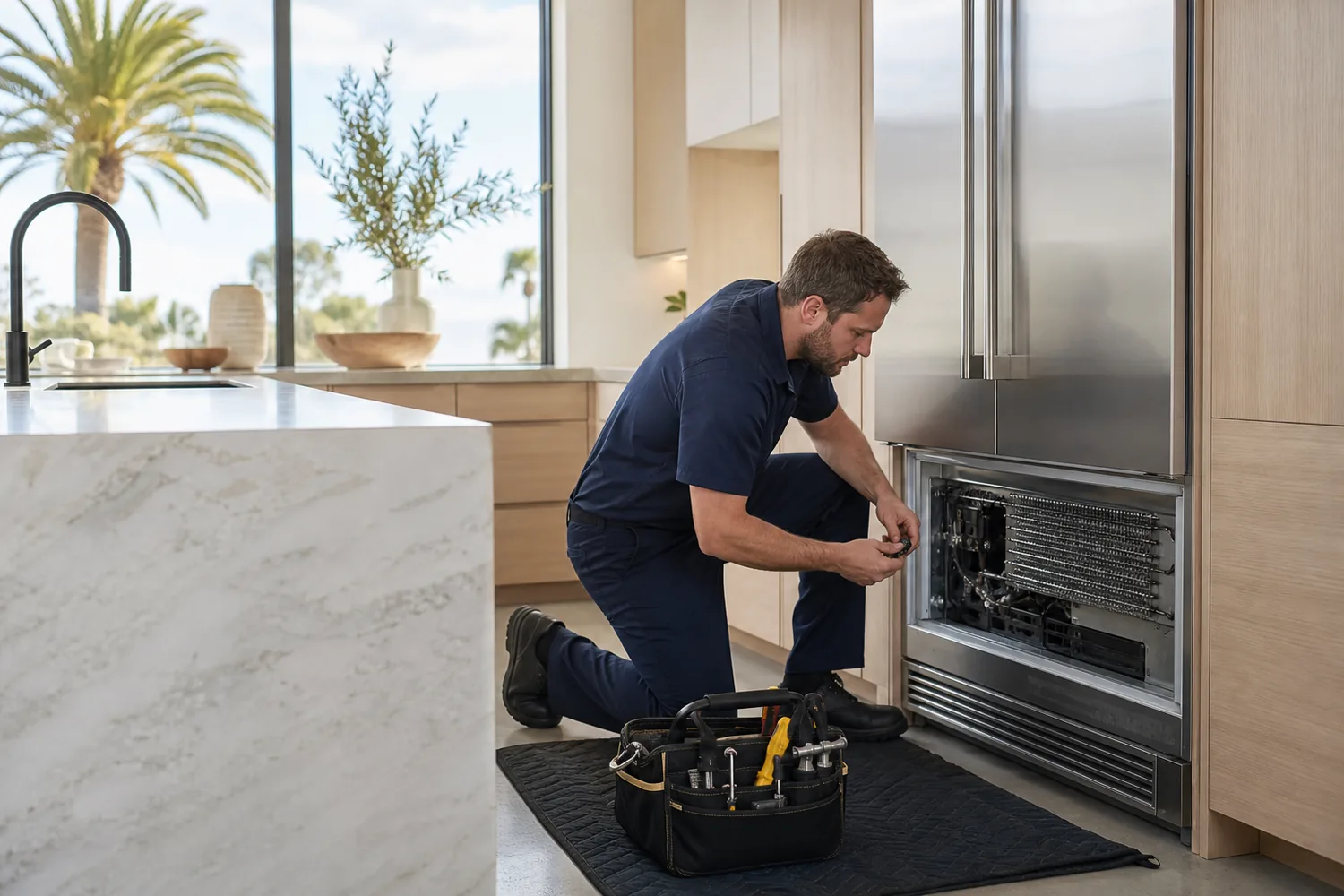
What a refrigerator is telling you.
Fresh food warm, freezer still freezing
Cold air is made in the freezer and moved to the fresh food side by a fan through a damper. When that side warms while the freezer holds, the evaporator fan has stopped, the damper is stuck shut, or the evaporator coil has iced over because the defrost heater, thermostat or control failed. Ice on the back wall of the freezer points at defrost. A fan you cannot hear points at the fan.
Both sides warm, compressor running or clicking
If the whole box is warm and the compressor hums, clicks and stops, the start relay or the compressor itself is the suspect, and a dirty condenser or a dead condenser fan makes both worse. If the compressor runs quietly and nothing gets cold, the sealed system has lost its charge. That is the one repair that needs a decision, and we give you the numbers before you make it.
Water where it should not be
A puddle inside the fresh food section is almost always the defrost drain, blocked with ice or food, sending meltwater into the crisper drawers instead of the pan. Water on the floor at the back is the fill line to the ice maker or the inlet valve. Water at the front is a door that no longer seals, sweating and dripping. All three are quick fixes when they are caught early and expensive when they are left.
What we repair on refrigerators.
Every refrigerator type, every major brand, freestanding and built in.
- Compressors, start relays, overload protectors and capacitors
- Evaporator and condenser fans, fan motors and blades
- Defrost heaters, defrost thermostats, timers and control boards
- Dampers, thermistors, temperature controls and main boards
- Water inlet valves, fill tubes, filters and dispenser parts
- Ice makers, ice maker modules and auger motors
- Door gaskets, hinges, closers and shelving that the door depends on
- Sealed systems on built-in and column refrigerators: leaks, evaporators, condensers, compressors
What refrigerator repair costs in California.
| Typical job | What usually causes it | Typical range |
|---|---|---|
| Fresh food side warm, freezer fine | Evaporator fan, defrost system or a stuck damper | $180 to $480 |
| Both sides warm | Condenser fan, start relay or a compressor fault | $180 to $480 |
| Water on the floor | Blocked defrost drain, water valve or a split fill line | $180 to $480 |
| Ice maker not producing | Fill valve, frozen fill tube or a worn module | $150 to $380 |
| Sealed system on a built-in | Refrigerant leak, compressor or evaporator | $800 to $2,200 |
The diagnostic visit is $89. The whole repair is quoted in writing before any work, you approve it first, and the fee is credited to the job when you go ahead.
A typical refrigerator repair, such as an evaporator fan, a defrost part, a start relay, a damper or a water valve, lands between $180 and $480 for parts and labor after the diagnostic fee is applied. Sealed system work on a built-in, meaning a refrigerant leak, an evaporator or a compressor, runs between $800 and $2,200 and is quoted separately after the leak is found.
The diagnostic visit is $89. It pays for a licensed technician to find the real fault, and it counts toward the repair when you go ahead. There is no hourly rate, the price you approve is the price you pay, and a return trip to fit an ordered part is inside the quote.
Repair it, or replace it?
A refrigerator under ten years old with one failed part is a repair almost every time. The parts that fail most, fans, relays, defrost components, valves and boards, cost a fraction of a new unit, and the repair leaves you with a machine that has years left. A built-in or panel-ready refrigerator is a repair well past fifteen years, because replacing one means cabinetry, a custom panel and often an electrician, on top of the appliance.
Replacement wins in a narrower set of cases. A freestanding unit past twelve years with a sealed system failure. A machine with several faults at once. A compressor on a budget model where the part alone is close to the value of the refrigerator. We tell you which case you are in, in writing, before you spend anything past the diagnostic fee.
What people ask before they call.
The compressor running is the sound of the refrigerator trying. Cooling still fails when the cold it makes cannot get to the food, or when it is not making cold at all. The first case is far more common. On a frost-free refrigerator the evaporator coil in the freezer ices over when the defrost heater, defrost thermostat or defrost control stops running its cycle, the evaporator fan then has nothing to blow through, and the fresh food side warms while the freezer feels cold and frosty. A fan that has stopped, or a damper stuck shut between the compartments, produces the same warm fresh food side without the frost.
The second case is a compressor that runs but cannot do its job. A condenser coil packed with dust and pet hair, a condenser fan that has quit, or a start relay that lets the compressor run weak all show up as a whole box that is warm and a compressor that is hot to the touch. If the compressor runs quietly and neither side gets cold, the sealed system has lost refrigerant, which is the one refrigerator fault that needs a repair or replace decision.
A technician tells these apart in the first visit with a thermometer, a meter and a look at the evaporator. Most of the parts involved ride on the truck. Call (888) 482-7007 and describe which side is warm; that alone narrows it down.
Most refrigerator repairs are one of a short list of parts, and the price follows the part. An evaporator fan, a condenser fan, a start relay, a defrost heater or thermostat, a damper, a thermistor, a water inlet valve or an ice maker module each land between $180 and $480 for parts and labor, after the diagnostic fee is applied. A main control board on a newer French door model sits at the top of that range because of the part price, not the labor.
The expensive end of refrigerator work is the sealed system: finding a refrigerant leak and replacing an evaporator, a condenser, a filter drier or the compressor. On a built-in or column refrigerator that runs between $800 and $2,200, and it is quoted separately once the leak is found, because the job depends on where it is.
Our structure is the same for every job. The diagnostic visit is $89, which pays for a licensed technician to find the actual fault rather than replace parts until it works. You get the full repair price in writing before any work, you approve it, and the diagnostic fee is credited toward the repair. There is no hourly rate, and if the honest answer is that the refrigerator is not worth fixing, that is the answer you get.
Usually, yes, and the reason is what fails at that age. Refrigerators past ten years lose fans, relays, defrost components, dampers, door gaskets and water valves, all of which are inexpensive parts that leave the machine with years of life once replaced. A ten or twelve year old refrigerator with one of those faults is a clear repair, because the alternative is spending many times the repair price on a new unit that will not last as long as the one you have.
The type of refrigerator matters more than the age. A built-in or panel-ready refrigerator is designed for a twenty year service life, and replacing one means a new unit at a high price plus cabinetry, a custom panel and often an electrician. That makes even a sealed system repair on a fifteen year old built-in the better number. A freestanding side by side or French door unit past twelve years with a compressor or refrigerant fault is where replacement starts to win.
The signs that a refrigerator is not worth repairing are several faults at once, a compressor failure on a budget model, or rust and damage to the cabinet and liner. We look at the whole machine during the diagnostic, not just the fault you called about, and the written quote comes with a plain recommendation. Call (888) 482-7007 and tell us the age and the model; we can often give you a view before the visit.
A freestanding refrigerator from a mass-market brand is built for about ten to fifteen years of service, and most of them get there with one or two repairs along the way. Built-in and column refrigerators are built for twenty, and the well made ones run past it, because the compressor and the sealed system are larger and the unit is serviced rather than discarded. Compact and garage refrigerators sit at the shorter end, partly because of where they live.
What shortens a refrigerator's life in California is heat and airflow. A condenser that is never cleaned makes the compressor run hotter and longer every year, and a refrigerator in a garage that hits over a hundred degrees in summer runs close to flat out for months. A door gasket that has hardened does the same thing quietly. Cleaning the condenser once a year and replacing a gasket when it stops holding a sheet of paper add real years.
What does not shorten it is a repair. A new evaporator fan or a new defrost thermostat at year eight does not reset the clock, but it does not start one either. The parts that fail are peripheral to the compressor, and the compressor is what determines the life of the box. If your refrigerator is inside its expected span and has a single fault, repairing it is the normal path.
Yes, and they are a large part of what we do in California. Counter-depth refrigerators are freestanding units with a shallower cabinet, and they are repaired the same way as any freestanding refrigerator. Built-in and panel-ready refrigerators are different machines: the compressor and condenser sit on top or at the base behind a grille, the unit is anchored into the cabinetry, the doors carry custom panels that add weight and change how the hinges and closers behave, and the sealed system is designed to be serviced in place.
That difference is why we assign built-in work to technicians who have worked the platform. Sub-Zero, Thermador, Monogram, Viking, Miele, Dacor, JennAir and Fisher and Paykel columns each have their own service literature, their own diagnostic modes and their own parts, and a technician who knows the unit finishes in one visit where a generalist orders the wrong part. We carry the common parts for the platforms we see most.
Panel removal and refit is part of the job, not an extra. If your built-in is warm, frosting, noisy or leaking, or the ice maker has stopped, call (888) 482-7007 with the brand and the model number from the plate inside the door, and we will send the right person.
Every region of California, one number.
Nine dispatch regions and 217 city pages. The technician who comes out works the area you live in.
The luxury platforms we repair for this job.
Assigned to a technician who has worked the platform, with the factory service literature open.
Refrigerator warm right now?
Keep the doors shut, move what you can to a cooler, and call (888) 482-7007. Same-day slots go first to refrigerators, because food does not wait, and a technician can usually tell you from the symptom whether the part is on the truck.