Thermador Oven, Range, Dishwasher and Refrigeration Repair in California
Thermador ovens carry more electronics than most of their rivals, and that is where a generalist gets lost. An oven that will not heat may be in demonstration mode, running on half of its 240 volt supply, or protecting itself with a tripped thermal fuse, and none of those needs a control module. We send technicians who check the cheap causes first and test the boards with a meter, not by replacement. Same day in most metros, one flat diagnostic fee, and the full price in writing before any work starts.
We are independent. We are not part of Thermador's service network and we do not process warranty claims. Inside the warranty, Thermador is the right first call; outside it, which is most Thermador appliances in California, you are choosing on skill and price.
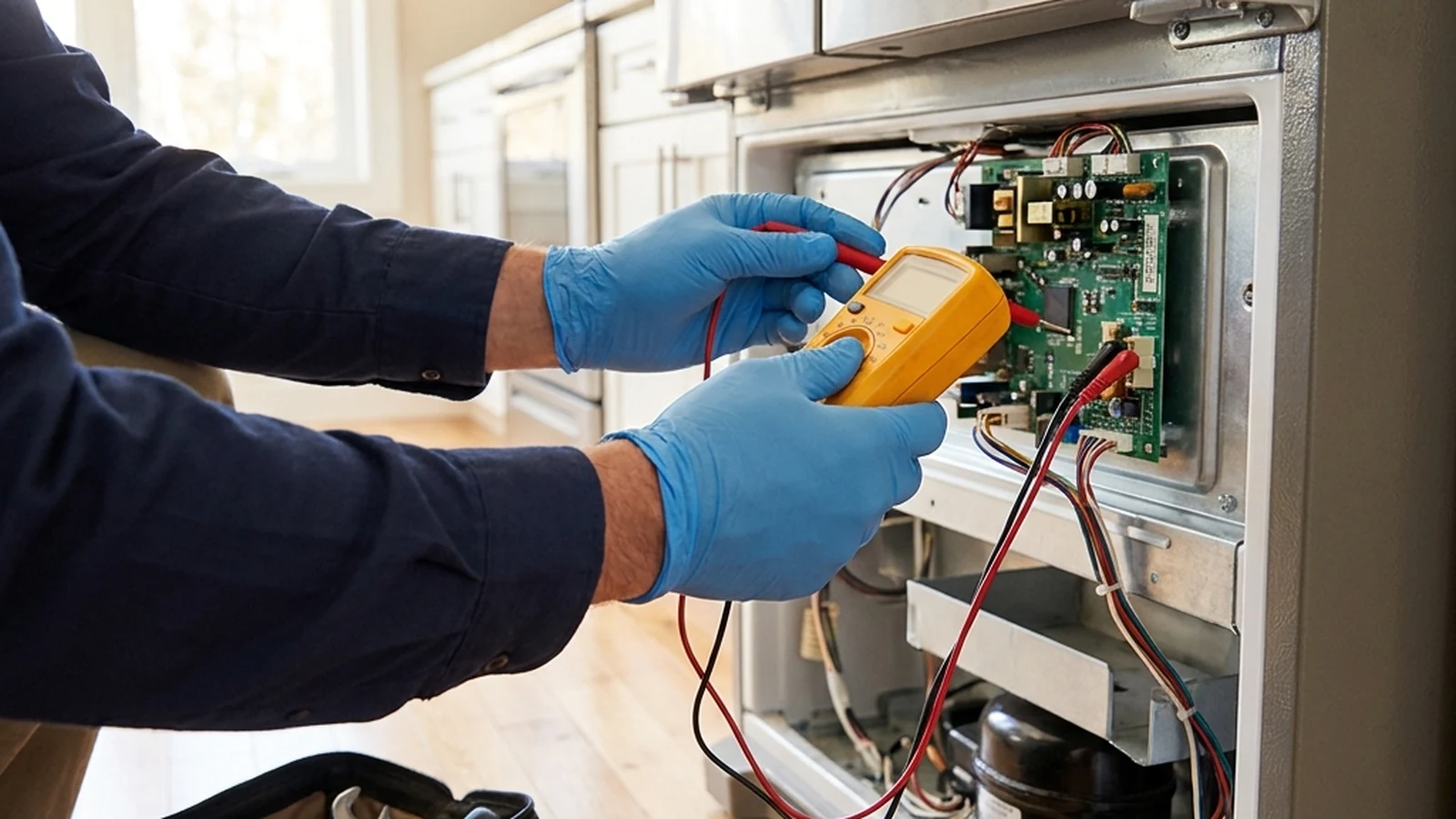
Where Thermador appliances fail.
Ovens and ranges: heat and control
The classic Thermador call is a wall oven with a working display and a cold cavity. In order: demonstration mode, a half tripped double pole breaker, a thermal fuse or high limit, then the parts that fail silently, a bake element, an oven igniter that never draws enough current, a relay board with a burned relay, or a temperature sensor so far off that the control never calls for heat. Star burner cooktops add the usual ignition faults: wet igniters, cracked electrodes and spark modules.
Dishwashers: water in, water out
Thermador dishwashers fail on the water path. A unit that will not drain has a packed filter, a jammed drain pump or a stuck check valve; one that fills slowly has a scaled inlet valve; one that leaves dishes wet has a heater or circulation pump fault. Control electronics and door latches cover most of the rest. A fault code in the display, when there is one, tells us which cycle timed out.
Freedom refrigeration: the same rules as any built-in
Columns and built-ins run warm for the same reasons as every luxury platform: a stopped evaporator fan, a failed defrost part, a hardened gasket, a dusty condenser, and on older units the sealed system. Ice makers stop on valves and frozen fill tubes. All of it is diagnosed with a thermometer, a meter and, when needed, gauges.
What we repair on Thermador.
- Professional and Masterpiece series ranges, rangetops and wall ovens, single and double
- Star burner gas cooktops, Freedom induction cooktops and electric cooktops
- Dishwashers, including panel ready and Star Sapphire models
- Freedom columns, built-in refrigerators, freezers and wine units
- Elements, igniters, spark modules, gas valves and temperature sensors
- Control modules, relay boards, power boards, displays and thermal fuses
- Drain pumps, circulation pumps, inlet valves, check valves and door latches
- Evaporator and condenser fans, defrost parts, gaskets, ice makers and sealed systems
What a Thermador repair costs in California.
Most Thermador repairs land between $300 and $900 for parts and labor after the diagnostic fee is applied. Igniters, elements, fuses, sensors, pumps, valves and door hardware sit toward the lower end; control and relay boards sit toward the upper end because the part costs more and takes longer to fit and program. Sealed system work on Freedom refrigeration typically runs between $800 and $2,200.
Diagnosis is a flat $89, and if you book the repair that fee becomes part of the payment rather than an extra. You get the complete price in writing before any work begins, there is no hourly clock, and if a module has to be ordered the return visit is inside the quote.
The Thermador warranty, plainly.
Thermador's standard coverage is a two year limited warranty on the entire appliance, parts and labor, across cooking, dishwashers, refrigeration and ventilation. Dishwashers add parts-only coverage on the electronics and the racks from year two through five and a lifetime parts-only warranty against rust-through of the tub and door. Built-in refrigerators add parts and labor on the sealed system from year three through six, parts only from year seven through twelve, and a lifetime rust-through term. There is no lifetime warranty on the appliance.
Inside those windows, contact Thermador so the repair is covered. Outside them, call (888) 482-7007.
What Thermador owners ask us first.
A Thermador wall oven or range will commonly serve 15 to 20 years, and units from the early 2000s are still working in kitchens across the state. The cavity, the door and the frame are not what ages. What wears is a short list of parts that a technician can replace: bake and broil elements or oven igniters depending on fuel, the convection fan motor, the oven temperature sensor, door hinges and gaskets, and the electronics that run the display and the relays that switch the heat.
The electronics are the part of that list most specific to Thermador. Its ovens have carried sophisticated controls for a long time, and a control module or relay board on a 12 to 15 year old unit is a normal repair rather than a sign the oven is finished. Thermador's own warranty on dishwashers extends parts coverage on the microprocessor and circuit boards to year five, which tells you the company plans for that part to be replaced, not the appliance.
An oven between 10 and 20 years old with a single fault is a repair in almost every case, because a comparable replacement is a four to five figure purchase before the cabinet cutout is adjusted for a new model's dimensions. The right question is not how old the oven is. It is whether the fault is on that list of replaceable parts, and on a Thermador it usually is.
Yes, almost without exception. A 10 year old Thermador wall oven is at the midpoint of its working life, and the faults that show up at that age are the ones every wall oven eventually has: an element or igniter, a temperature sensor that has drifted, a convection motor, a door hinge, a control or relay board. Each of those is a defined part with a defined price, and none of them come close to the cost of a new built-in oven of the same width plus the trim and cabinet work that a replacement often forces, because cutout dimensions change between generations.
The exception is physical damage or a fault in the cavity itself, such as a cracked liner or a door that has been bent, and even those are worth a look before deciding. Another case worth thinking about is a double oven with faults in both cavities and a control problem on top, where the total on the written quote is what you compare against a new unit, not the age.
There is also a practical point about 10 year old Thermadors: parts are available. The control modules, sensors, elements and hinges for this generation are stocked, and the repair is usually one visit if the part is common and two if it has to be ordered. Our diagnostic fee is $89, credited to the repair, and the price comes in writing before any work starts.
On Thermador cooking products the common calls are an oven that will not heat, heats slowly or runs off temperature, a range burner that clicks without lighting or lights unevenly, and a control panel that is unresponsive or showing an error. Behind those are the usual suspects, elements, igniters, spark modules, temperature sensors, and the control and relay boards, plus a few that are specific to the platform: an oven that will not heat because it was left in demonstration mode, and an electric oven that displays normally but never gets hot because one leg of its 240 volt supply has dropped out at the breaker.
On Thermador dishwashers, the pattern is water and drainage: a unit that will not drain, fills slowly or shows a fault code, which points to the drain pump, the circulation pump, a clogged filter or a water inlet valve. Control electronics and door latches make up most of the rest. Thermador's warranty singles out the electronics and the racks for extended parts coverage, which matches what we see wearing.
On Thermador built-in refrigeration and freezer columns, the calls are the same as on any luxury built-in: a section that runs warm, frost from a failed defrost part or a worn gasket, an ice maker that has stopped, a fan that has become noisy, and on older units a sealed system fault. All of it is repairable by a technician who knows the platform.
An oven that is silent about its own failure is telling you the control thinks everything is fine, which points to a short list. First, check the mode. Thermador ovens have a demonstration mode for showrooms that lets the display and lights work while the heating is disabled, and it can be switched on by accident during a power blip or a button sequence. The use and care guide describes how to turn it off, and it is the first thing our technicians check because it costs nothing.
Second, on an electric or dual fuel oven, look at the breaker. The oven's electronics run on 120 volts and its elements on 240. A double pole breaker that has half tripped, or a loose connection on one leg, leaves the display working normally while the oven never heats. Flip the breaker fully off and back on. If it trips again, the fault is in the oven or the circuit and needs a technician.
Third are the parts that fail without the control noticing: a bake element that has burned open, a gas oven igniter that glows but never draws enough current to open the valve, a thermal fuse or high limit that has tripped after an overheat or a self clean cycle, or a relay board with a failed relay. Each is a quick test with a meter. If demo mode and the breaker are ruled out, stop there and call (888) 482-7007. Replacing parts by guesswork on a Thermador gets expensive quickly.
Most Thermador oven repairs land between $300 and $900 for parts and labor, after the diagnostic fee is applied, and the position inside that range is decided by the part. At the lower end sit igniters, elements, thermal fuses, temperature sensors and door hardware. At the upper end sit the electronics: a control module, a relay board or a power board, which cost more as parts and take longer to fit and program. Genuine Thermador parts are priced above generic equivalents, and we use them because a temperature sensor with the wrong resistance curve makes an oven bake wrong for years.
Two things can push a quote outside that band. A double wall oven with faults in both cavities is two repairs, and a job that turns out to be the wiring or the circuit rather than the oven is an electrician's job we will point you toward rather than guess at.
Our diagnostic fee is $89. You get the complete price in writing before any work begins, the fee is credited to the repair when you go ahead, and there is no hourly clock. If a control module has to be ordered, the return visit is inside the quote. And if the honest answer is that the oven is not worth the repair, you will hear it, and you will have paid for a diagnosis rather than a parts lottery.
No. Thermador's standard coverage is a two year limited warranty on the entire appliance, parts and labor, and it applies across cooking, dishwashers, refrigeration and ventilation. A few product lines carry longer coverage on specific parts. Dishwashers get parts-only coverage on the electronics (the microprocessor or printed circuit board) and on the racks from year two through year five, and a lifetime parts-only warranty against rust-through of the inner tub and stainless door. Built-in refrigerators get parts and labor on the sealed refrigeration system (compressor, evaporator, condenser, dryer and connecting tubing) from year three through six, then parts only from year seven through twelve, plus a lifetime rust-through term on the door and liner. Cooking products and ventilation carry the two year term without extensions.
If your appliance is inside one of those windows with a covered fault, contact Thermador first so the work is arranged through its service network and the parts are supplied under the warranty. We are an independent repair company and we do not process warranty claims.
Outside those windows, which describes most Thermador appliances in California, the warranty no longer figures in the decision. You are choosing a technician on skill and price, and Thermador ranges, wall ovens, cooktops, dishwashers and refrigeration are platforms we repair every week with genuine parts and a written quote before the work.
Start with the two causes you can check yourself. First, the filter. Thermador dishwashers have a cylindrical filter assembly in the floor of the tub that traps food, glass and labels, and when it is packed the pump cannot move water. Twist it out, rinse it, and check the sump beneath it for a broken glass fragment or a fruit pit. Second, the drain path. If the dishwasher shares a disposal, a disposal that was replaced recently may still have its knockout plug in place, and a drain hose that has been kinked under the sink or has lost its high loop will leave water standing in the tub. Both are common after kitchen work.
If the filter is clean and the hose is clear, the fault is inside the machine. The drain pump can fail electrically or jam on debris that got past the filter. A check valve in the drain can stick. On some models a fault code will appear in the display when a drain cycle times out; if you see one, note it, because it tells the technician which cycle failed. A dishwasher that fills and washes but leaves an inch of water is a drain problem; one that will not start at all may be a door latch or a control.
Do not run the dishwasher repeatedly against standing water. Bail it, keep the code, and call (888) 482-7007. Drain pumps and check valves are parts we carry, and this is usually a single visit repair.
The other luxury brands we repair.
Thermador cold, wet or throwing a code? Call now.
Read us the model number and whatever the display shows, and we will send a technician who has worked on it. If the oven display is lit but the cavity is cold, try the breaker and the demo mode setting first; if neither fixes it, stop there. (888) 482-7007 is staffed 7 days, from 6 in the morning until midnight.