Washing Machine Repair Across California
A washer that stops with a tub full of water, will not spin the load dry, leaks across the laundry room floor or walks itself away from the wall is a machine with one failed part, not a lost cause. Drain pumps, lid locks, door locks, shifter actuators, inlet valves, suspension rods and drum bearings are the parts that do most of the failing, and a licensed technician carries most of them.
We repair front load, top load, high efficiency, agitator, stacked and all-in-one washers from every major brand, in houses, condos and the compact closets that stacked units live in. Same day in most metros, one flat diagnostic fee, and the complete price in writing before any work begins.
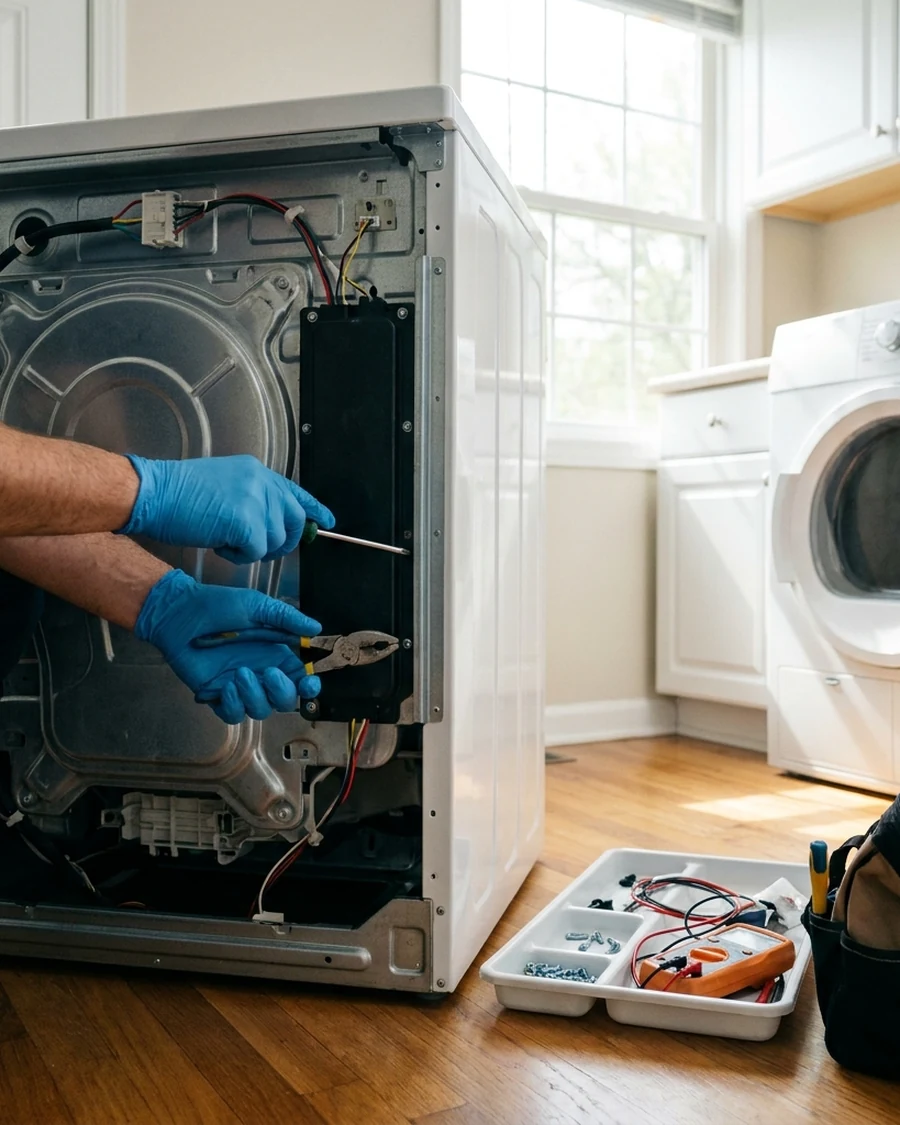
What a washer is telling you.
Full of water and will not drain
The drain pump has stopped, or something is stopping it. On front loaders a coin, a hair tie or a sock in the pump filter is the first thing we check. After that the pump itself, a kinked or clogged drain hose, or a control that never sent the pump the signal. A washer that drains but will not spin has usually lost its lid lock, door lock or shifter actuator, because the control refuses to spin a drum it cannot confirm is locked.
Loud spin, thumping, or walking
A roar on high spin that gets worse every month is drum bearings, and on a front loader the seal that protects them has usually let water in. A thump on every rotation is a suspension rod, a damper or a loose counterweight. A machine that walks across the floor has lost its suspension or was never leveled. Bearings are a real job. The rest is usually a single visit.
Leaking, or filling slowly
Water at the front of a front loader is the door boot, torn or holding a foreign object in its fold. Water at the back is a supply hose, an inlet valve or the drain hose. A machine that fills slowly or shows a fill error on a hard water supply often just has scaled inlet screens, which is a fifteen minute fix. A machine that fills and never stops has a stuck valve or a pressure switch fault.
What we repair on washers.
Front load, top load, stacked and all-in-one, every major brand.
- Drain pumps, pump filters, drain hoses and check valves
- Lid locks, lid switches, door locks and door latch assemblies
- Shifter actuators, motor couplings, clutches and drive belts
- Drum bearings, tub seals, spiders and drive shafts
- Suspension rods, dampers, springs and counterweight hardware
- Inlet valves, pressure switches, hoses and water level sensors
- Door boots, gaskets, hinges and door glass
- Control boards, user interfaces, motor controls and wiring
What washer repair costs in California.
| Typical job | What usually causes it | Typical range |
|---|---|---|
| Will not drain | Drain pump, filter obstruction or the hose | $160 to $450 |
| Will not spin | Lid lock, door lock, motor coupling or a shifter actuator | $160 to $450 |
| Leaking | Door boot, inlet valve, hose or a pump seal | $160 to $450 |
| Loud spin, walking across the floor | Drum bearings, suspension rods or dampers | $160 to $450 |
| Will not fill or fills slowly | Inlet valve, pressure switch or scaled inlet screens | $160 to $450 |
The diagnostic visit is $89. The whole repair is quoted in writing before any work, you approve it first, and the fee is credited to the job when you go ahead.
A typical washing machine repair, such as a drain pump, a lid lock, a door lock, an actuator, an inlet valve or a set of suspension rods, lands between $160 and $450 for parts and labor after the diagnostic fee is applied. A drum bearing and seal job sits at the top of that range because the machine has to come apart, and we tell you before starting whether the machine is worth it.
The diagnostic visit is $89. It is credited to the repair when you go ahead. There is no hourly rate and no surprise on the invoice: the price you approve in writing is the price you pay.
Repair it, or replace it?
A washer under eight years old with a single failed part is a repair. Pumps, locks, actuators, valves and hoses are inexpensive parts on a machine that has years of life left. A stacked laundry center or an all-in-one is a repair well past that, because replacing one means a matched unit and often an installer who can get it into the closet.
Replacement is the honest answer when a front loader past ten years needs bearings and has other wear, when a budget top loader needs a transmission, or when a machine has rusted through at the tub or the cabinet. Those are the cases where the repair total approaches the price of a new machine that will last another decade. We put both numbers in front of you before you decide.
What people ask before they call.
The calls we take most are drain and spin. A front loader that stops full of water almost always has something in the drain pump filter, a coin, a hair tie, a sock, or a drain pump that has failed. A machine that drains but will not spin has lost its lid lock or door lock, because the control refuses to spin a drum it cannot confirm is locked, or on many top loaders the shifter actuator that moves the transmission between agitate and spin. Those three account for most washer visits and most of them finish in a single trip.
Next come water problems. A machine that fills slowly or throws a fill error on a hard water supply usually has scaled inlet screens, which is a quick fix, and one that fills and never stops has a stuck inlet valve or a pressure switch fault. Leaks come from the door boot on a front loader, the hoses and the inlet valve at the back, or a pump seal underneath.
Then noise. A front loader that roars on high spin has drum bearings going, usually because the seal that protects them has let water through, and that is the one washer repair that costs real money. A thump on every rotation is a suspension rod or a damper. Control board faults are the least common of the lot, though they get blamed first. Call (888) 482-7007 with the symptom and the type of machine; most of these have a known fix.
A washing machine repair follows the part, and the parts that fail most are not the expensive ones. A drain pump, a lid lock, a door lock, a shifter actuator, an inlet valve, a pressure switch, a door boot or a set of suspension rods each lands between $160 and $450 for parts and labor after the diagnostic fee is applied. Clearing a blocked pump filter or a kinked hose with no part needed is at the bottom of that range.
The job at the top of the range is drum bearings on a front loader. The machine has to be substantially disassembled to press the bearings out of the outer tub, and on some models the maker sells the tub and bearings as one assembly. We quote that job in writing and we say whether the machine is worth it. A control board on a newer high efficiency machine is the other job that can run high, because of the part price.
Every washer job starts with a $89 diagnostic visit, which pays for a licensed technician to find the real fault rather than replace parts in turn. You get the whole price in writing before any work starts, the fee is credited when you go ahead, and there is no hourly rate. If the machine is not worth fixing, you get that on paper too.
At eight years a washer is in the second half of its expected life, and whether it is worth repairing depends almost entirely on what has failed. A drain pump, a lock, an actuator, an inlet valve, a hose or a set of suspension rods on an eight year old machine is a repair without much debate. Those parts are inexpensive, the repair is one visit, and the machine will run for years afterward.
The fault that changes the math is drum bearings on a front loader. The bearing and seal job is the most involved washer repair there is, and on an eight year old machine that also shows rust at the spider, a worn door boot and a tired pump, the total can approach a new washer that will run another decade. A transmission or a motor on a budget top loader is a similar case. When we see either, we put the repair number and a replacement estimate side by side before you decide.
Two things push toward repairing. A stacked laundry center or an all-in-one unit is expensive to replace and often needs an installer who can get it into the closet, so it is worth more repair than a freestanding machine. And a well made washer from a brand with a long parts supply is worth keeping at eight years, because its replacement is not certain to be better. Call (888) 482-7007 with the brand and the symptom and we can usually say which side of the line you are on.
Ten to thirteen years is the normal range for a washing machine, with well made front loaders and simple top loaders at the long end and budget high efficiency machines at the short end. That figure assumes a family's worth of loads a week. A machine in a single-person household runs longer; one serving a large family, a home with sports uniforms and work clothes, or a short-term rental runs shorter, because life is measured in cycles more than years.
What wears a washer is weight and water. Overloading strains the suspension, the bearings and the motor, and a front loader run on the wrong detergent or without its door left open between loads grows the residue that leads to smell and seal damage. Hard water, which most of California has, scales the inlet screens and the heater on machines that have one, and shortens the life of hoses and valves.
The maintenance that extends life is small: replace rubber supply hoses with braided ones before they burst, run a cleaning cycle monthly on a front loader, clean the pump filter every few months, and level the machine so it does not walk. A washer inside that ten to thirteen year window with a single fault is a repair; one well past it with a major fault is usually replaced. We tell you which in writing after the diagnostic.
The smell is biofilm. A front loader seals its door with a large rubber boot, and the folds of that boot, the outer tub and the drain pump hold a little water after every cycle. Cold washes, too much detergent and a door kept shut between loads let bacteria and mold grow in that water, and the machine starts to smell of mildew that transfers to towels. It is the most common complaint about front loaders and it is almost never a mechanical fault.
Most of it is fixed without a technician. Pull the boot back and wipe the folds with a diluted bleach solution, clean the detergent drawer and its housing, empty and rinse the drain pump filter, run the hottest cycle with a washer cleaner or a cup of bleach and no laundry, and leave the door and the drawer open between loads. Use high efficiency detergent and less of it than the cap suggests. Done monthly, that keeps a front loader clean.
Where we come in is when the boot has blackened mold grown into the rubber, when it has torn, or when the smell is coming from a drain pump or a drain hose that is not clearing. A boot that will not come clean is replaced, which is a straightforward single visit, and while it is off we check the tub and the pump. A machine that also drains slowly may have a partially blocked pump, which is the same visit. Call (888) 482-7007 if the cleaning routine does not clear it in two cycles.
Every region of California, one number.
Nine dispatch regions and 217 city pages. The technician who comes out works the area you live in.
The luxury platforms we repair for this job.
Assigned to a technician who has worked the platform, with the factory service literature open.
Washer stuck with a load inside?
Do not force the door. Call (888) 482-7007, tell us the symptom and the brand, and we will give you a time window. Most drain and lock faults are finished in a single visit with the part on the truck.