Built-In and Over-the-Range Microwave Repair Across California
A countertop microwave that stops heating is usually replaced. A built-in microwave behind a trim kit, a microwave drawer set into the island, an over-the-range unit that is also the kitchen's vent hood, or the microwave half of a combination wall oven is a different decision, because replacing it means matching a cutout, a trim kit or a wall oven cabinet, and often means a two-person install. Those are the microwaves we repair.
The faults are a short list: a magnetron, a high voltage diode, a capacitor or a transformer when it runs without heating, a fuse or a door switch when it is dead, a waveguide cover when it sparks. Same day in most metros, one flat diagnostic fee, the full price in writing before any work.
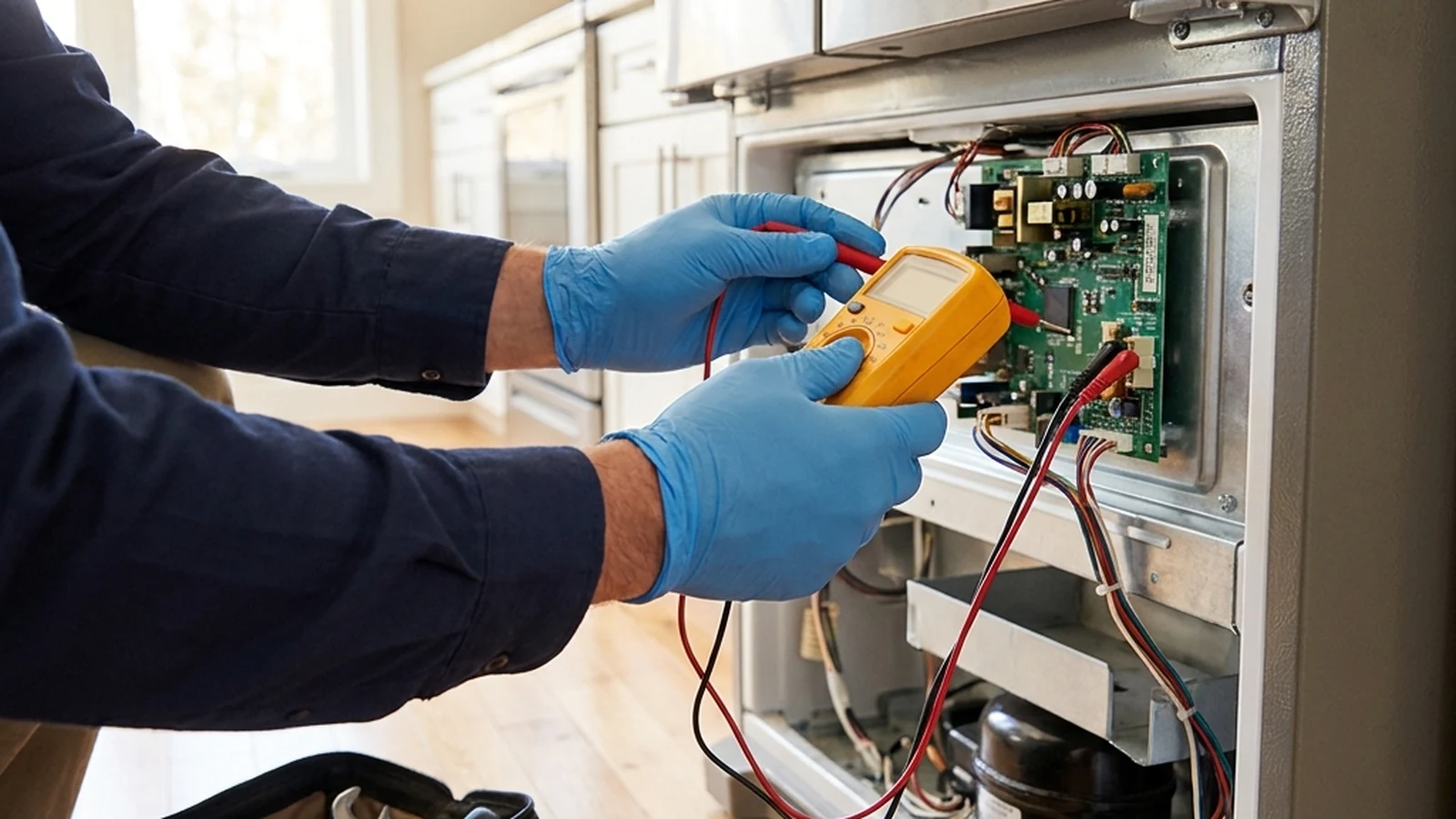
What a microwave is telling you.
Lights on, turntable turning, food cold
The high voltage circuit has failed. The magnetron produces the microwaves, the transformer, capacitor and diode feed it, and any one of the four takes the heat away while the rest of the unit runs normally. A quiet buzz with no heat often points at the diode or the capacitor. A loud hum and a smell points at the magnetron. Each is a test with a meter for a technician who knows to discharge the capacitor first, and none of them is a job for a homeowner.
Sparking or arcing inside
Sparks inside a microwave are metal, or the absence of the cover that protects the waveguide. A rack support that has lost its coating, a chipped patch of interior paint, a piece of foil, or a waveguide cover that has absorbed grease and burned through all arc. The cover is an inexpensive part. Damage to the cavity wall is what decides whether the microwave is worth keeping.
Dead, no display, or door will not latch
A microwave with no display has a blown line fuse, and a fuse blows for a reason, usually a door switch that failed out of sequence or a shorted component. A door that does not close or latch is a hook, a spring or a hinge, and the microwave will not start until the switches agree the door is shut. Both are single visit repairs when the door assembly is still available for the model.
What we repair on microwaves.
Built-in, drawer, over-the-range and combination wall oven microwaves, every major brand.
- Magnetrons, high voltage diodes, capacitors and transformers
- Line fuses, thermal fuses, door switches and interlock assemblies
- Door latches, hooks, springs, hinges and door glass
- Waveguide covers, stirrer motors, turntable motors and couplers
- Cooling fans, vent hood fans, filters and charcoal filter housings
- Control boards, touchpads, membrane switches and displays
- Trim kit removal and refit for built-in units
- Over-the-range mounting, bracket and vent duct repairs
What microwave repair costs in California.
| Typical job | What usually causes it | Typical range |
|---|---|---|
| Runs but no heat | Magnetron, high voltage diode, capacitor or transformer | $140 to $360 |
| Sparking inside | Waveguide cover, rack support or a damaged interior | $140 to $360 |
| Dead, no display | Fuse, door switches or a control board | $140 to $360 |
| Turntable or fan not running | Turntable motor, coupler or a cooling fan | $140 to $360 |
| Door will not latch | Latch, hinge or a door switch | $140 to $360 |
The diagnostic visit is $89. The whole repair is quoted in writing before any work, you approve it first, and the fee is credited to the job when you go ahead.
A typical microwave repair, such as a door switch set, a fuse and its cause, a diode, a capacitor, a magnetron, a waveguide cover or a turntable motor, lands between $140 and $360 for parts and labor after the diagnostic fee is applied. A magnetron on a large built-in sits at the top of that range. A countertop unit is almost never worth that number, and we say so on the phone.
The diagnostic visit is $89, credited to the repair when you go ahead. You approve the whole price in writing before any work starts, and a return trip to fit an ordered part is inside it.
Repair it, or replace it?
The question for a microwave is what replacing it involves. A built-in with a trim kit, a drawer, or the microwave in a combination wall oven is a repair almost every time, because the replacement has to match a cutout or a cabinet, the trim kit may no longer be sold, and the install is a real job. An over-the-range unit is a repair when it is under eight years old and the fault is a switch, a fuse, a diode or a cover.
Replacement makes sense when a countertop unit fails at all, when an over-the-range unit past ten years needs a magnetron, or when the cavity has arced through the wall. A combination wall oven with a failed microwave side is repaired, not replaced, because the alternative is a new double oven and a carpenter.
What people ask before they call.
Everything you can see and hear on a microwave, the light, the fan, the turntable and the timer, runs on ordinary household power. The heat comes from a separate high voltage circuit: a transformer steps the voltage up, a capacitor and a diode shape it, and a magnetron turns it into the microwaves that cook the food. When any one of those four fails, the microwave runs a perfect cycle and the food comes out cold.
Which one it is has a few tells. A loud hum that was not there before, or a smell of something electrical, points at the magnetron or the transformer. A quiet run with no heat often points at the diode, which is the cheapest part in the circuit, or the capacitor. A microwave that heats for a few seconds and stops, or that trips the breaker when it starts, points at the magnetron or a shorted capacitor. Door switches can also fail in a way that lets the microwave run without enabling the high voltage side.
This is not a circuit to open at home. The capacitor holds a charge that can injure or kill after the microwave is unplugged, and a technician discharges it before touching anything. On a built-in, drawer or over-the-range unit, a diode, a capacitor or a magnetron is a worthwhile single visit repair. Call (888) 482-7007 with the brand and the model number from inside the door.
A microwave repair is priced by which part of the machine has failed. A door switch set, a line fuse and the fault that blew it, a high voltage diode, a capacitor, a waveguide cover, a turntable motor or a door latch assembly each lands between $140 and $360 for parts and labor after the diagnostic fee is applied. A magnetron on a large built-in or a combination wall oven sits at the top of that range, because of the part price.
That range only makes sense on the microwaves we repair: built-in units behind a trim kit, microwave drawers, over-the-range units that are also the vent hood, and the microwave half of a combination wall oven. On a countertop microwave the same repair costs more than the unit is worth, and we say so on the phone rather than send a technician to tell you in person.
Every job begins with a $89 diagnostic visit, which covers the technician safely discharging the high voltage circuit and testing the components in it. You get the full price in writing before any work, you approve it, and the fee is credited toward the repair. There is no hourly rate. If the cavity has arced through or the part is no longer made, the written quote says so and recommends replacement.
A built-in microwave, yes, in nearly every case, and the reason is the cutout. A built-in sits behind a trim kit sized to a specific cabinet opening, a microwave drawer is set into an island or a run of base cabinets, and a combination wall oven has the microwave built into the same chassis as the oven. Replacing any of them means finding a current model that fits the same opening, a trim kit that may no longer be sold, and an installer. Against that, a door switch, a fuse, a diode, a capacitor or even a magnetron is a small number, and the repair is a single visit.
An over-the-range microwave is a closer call. It is easier to replace than a built-in, but it is still a two-person install onto a wall bracket with the vent duct connected, and the unit is also the kitchen's range hood. Under eight years old with a switch, fuse, diode, latch or cover fault, repair it. Past ten years with a failed magnetron, the numbers start to favor a new unit, and we will tell you when they do.
The one case where we say replace regardless of age is a cavity that has arced through the wall or a floor that has rusted through, because the unit is no longer safe to run. Call (888) 482-7007 with the brand, the type of installation and the symptom, and we can usually give you a plain answer before anyone comes out.
Eight to ten years is the normal life of a microwave, and it is set by the magnetron, which wears with every minute of cooking and eventually loses its output. Built-in and drawer microwaves tend to reach the long end because they are used less hard than the family countertop unit and are worth servicing when a smaller part fails. Over-the-range units sit in the middle, partly because they also work as a vent hood and collect grease and heat from the cooktop below.
What shortens a microwave's life is running it empty or nearly empty, which sends the energy back at the magnetron, and heat the unit cannot shed. An over-the-range microwave with a grease-loaded filter, a built-in whose trim kit vents are blocked, or any unit whose cooling fan has slowed will cook its own electronics. A waveguide cover left to absorb grease until it burns is a small part that takes the magnetron with it if it is ignored.
The habits that help are simple: never run it empty, keep the interior and the waveguide cover clean, wash or replace the grease filter on an over-the-range unit, and keep the vents clear. A microwave inside its expected life with a switch, fuse, diode or latch fault is a repair on a built-in or over-the-range unit; a countertop unit of any age with any fault is generally replaced, and we say so on the phone.
The earliest sign is food that takes longer than it used to. A magnetron loses output gradually before it fails, so a cup of water that once boiled in two minutes takes three, and the change is easy to miss until it is large. A new hum, buzz or rattle during cooking is the next sign, and it usually means the magnetron, the transformer or the cooling fan. A smell of hot electrical parts, or of burning from behind the panel, is a sign to stop using it.
Sparks or flashes inside the cavity are the sign most people notice first. They come from metal, from a rack support that has lost its coating, from a chipped patch of interior paint, or from a waveguide cover on the side wall that has absorbed grease and started to burn. The cover is an inexpensive part and the microwave is fine once it is replaced. Damage to the cavity wall itself is what makes a microwave not worth keeping.
Then the door and the controls. A door that has to be slammed to make the microwave start, a display that flickers or a keypad with a dead button, a turntable that stops or a fan that runs on after the cycle are all signs of a specific part wearing out, and on a built-in, drawer or over-the-range unit each is a repair. If yours is showing more than one of these at once, call (888) 482-7007 and tell us which; the combination often names the fault.
Every region of California, one number.
Nine dispatch regions and 217 city pages. The technician who comes out works the area you live in.
The luxury platforms we repair for this job.
Assigned to a technician who has worked the platform, with the factory service literature open.
Built-in microwave down?
Call (888) 482-7007 with the brand and the symptom. Tell us if it is behind a trim kit, in a drawer or over the range, and we will send a technician who carries door switches, fuses and diodes for the common models.