Appliance Repair in Camarillo, CA
One number for every major appliance in Camarillo. A technician who lives in the area, common parts on the truck, and a repair price you approve before a single panel comes off.
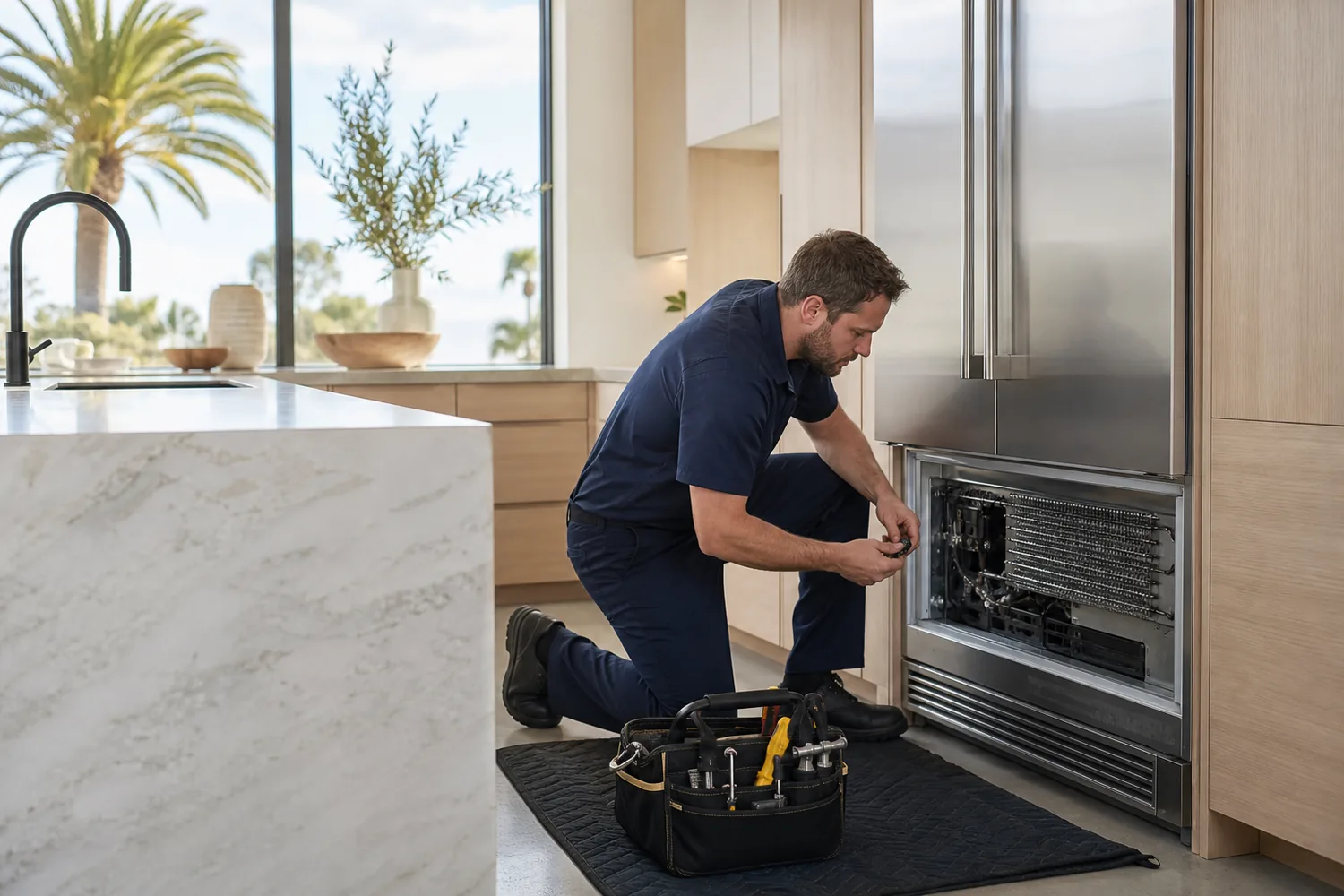
Every Camarillo ZIP code, one number.
Camarillo is a city of about 69,881 people in Ventura County. Around 57.6 percent of homes are detached houses and the median home was built in 1982, so most of what we see is a full-size kitchen and a garage or side-yard laundry. We run Central Coast as one dispatch area, and Camarillo sits inside it with 3 delivery ZIP codes. One technician group covers all of Camarillo; the ZIP codes below are the delivery areas we serve.
Not sure if we reach you?
Tell us the cross street. We will tell you the time window in about ten seconds.
Every major appliance, freestanding or built in.
Refrigerator & freezer
Not cooling, leaking, loud compressor, warm freezer. Freestanding, counter depth and built-in columns.
Washer
Will not spin, will not drain, leaking or walking. Front load, top load and stacked.
Dryer
No heat, endless cycles, thermal shutdown. Gas and electric, plus the vent run that causes half the calls.
Dishwasher
Not draining, not cleaning, leaking, stuck mid cycle. Panel-ready and integrated units included.
Oven, range & cooktop
Burners that will not light, uneven baking, dead board. Gas, electric, induction and dual fuel.
Ice maker
No ice, slow ice, small hollow cubes, flooded bin. Under counter and built-in units too.
Microwave & disposal
Built-in, drawer and over-range microwaves, jammed disposals, vent hoods and warming drawers.
SPECIALISTBuilt-in & luxury
Sub-Zero, Viking, Thermador, Wolf, Miele and Dacor. Assigned to a technician who has worked the platform.
What Camarillo repairs actually cost.
Nobody else on this search result will show you a number before you call. Here is the honest range, and what moves it.
| Typical Camarillo job | What usually causes it | Typical range |
|---|---|---|
| Dishwasher not draining or not cleaning | A blocked sump, a tired drain pump or a failed inlet valve | $150 to $400 |
| Ice maker not producing | A failed fill valve, a frozen fill tube or a worn module | $150 to $380 |
| Refrigerator not cooling | Condenser fan, defrost system or a start relay | $180 to $480 |
| Dryer runs but will not heat | Element, thermal fuse or igniter | $140 to $380 |
| Washer will not drain | Drain pump, filter obstruction or the hose | $160 to $450 |
| Oven not heating evenly | Igniter, bake element or a calibration drift | $160 to $480 |
| Built-in refrigerator sealed system | Refrigerant charge, compressor or evaporator on a built-in | $800 to $2,200 |
One flat diagnostic fee of $89 gets a licensed technician to your door. The full repair is quoted before any work starts, you approve it first, and the diagnostic fee goes toward the job when you book the repair.
What people here ask us first.
Not cooling properly, and behind that symptom the most common cause is the defrost system. Every frost-free refrigerator melts the frost off its evaporator coil a few times a day using a heater, a defrost thermostat and a timer or control. When any of the three fails, the frost never clears, it builds into a block of ice, and the fan that should be moving cold air is blowing against a wall. The refrigerator section warms first, the freezer often stays cold, and the problem gets worse gradually over a week or two. Behind the defrost system come the fans, the evaporator fan that moves cold air into the cabinet and the condenser fan that keeps the compressor cool, and then dirty condenser coils, which starve the machine of the ability to shed heat.
What all three have in common is that they are airflow problems, not refrigeration problems. The sealed system is still making cold; the cold is not getting where it should. That is good news, because airflow faults are routine repairs with common parts.
If your refrigerator is warm, the useful things to notice before calling are whether the freezer is also warm, whether you can hear the fan, and whether there is frost on the back interior wall of the freezer. Those three observations narrow the diagnosis considerably.
When a freezer runs but the contents go soft, the cold is usually being made and not delivered. The evaporator coil at the back is getting cold; the air is not moving across it and out into the cabinet. Two things cause that. The first is the evaporator fan. If it has seized or the motor has failed, cold pools around the coil and the rest of the space warms. You can often hear the difference: a healthy freezer has a quiet, steady fan note behind the hum of the compressor, and a failed one goes silent or grinds. The second is ice. Every frost-free freezer runs a defrost cycle a few times a day to melt the frost off the coil. When the heater, the defrost thermostat or the control that triggers the cycle fails, the frost never clears, it grows into a block, and the fan is blowing against a wall of ice. The tell-tale is frost on the back interior panel and a freezer that got worse gradually over a couple of weeks.
In a refrigerator with a freezer on top or bottom, a blocked damper or a vent covered by a bag of peas does the same thing to one compartment. Airflow faults are the good news in freezer repair. They are diagnosed quickly, the parts are common, and the freezer usually has years left in it.
For a microwave that is part of a matching kitchen, the answer tilts hard toward repair. A built-in microwave in a wall oven suite from Wolf, Thermador, Miele, Monogram, Bosch or a similar maker was chosen to match the oven beside or below it, in finish, in handle, in control layout. When that line is discontinued, replacing the microwave means either a unit that does not match, or replacing the oven as well to restore the set, and either is a far larger expense than any microwave repair. The same applies to a microwave drawer set into a custom island, where the cutout was made for that model.
So on these units, repair the door switch, the fuse, the diode, the capacitor, the turntable motor, the control panel, and the magnetron, and think about replacement only for a damaged door or cavity, or a control board that cannot be had. Typical repairs run $140 to $360, parts and labor, against a replacement that is several times that once the match and the installation are counted.
Our diagnostic visit is a flat $89, credited to the repair when you go ahead, and built-in and luxury microwave work goes to technicians trained on the platform. We service built-in, drawer and over-the-range units, not countertop microwaves.
It does, cumulatively rather than suddenly, and only the appliances that touch water. Scale is the mineral that hard water leaves behind when it heats or evaporates, and it does three kinds of damage. It narrows openings: water inlet valves, fill tubes, spray arm holes and dispenser lines shrink until the appliance fills slowly, fills unevenly or stops filling. It insulates: scale on a heating element makes the element work harder and hotter to reach temperature, which shortens its life and lengthens cycles. And it abrades: mineral crystals in the water wear on pump seals and door seals every cycle until one starts weeping.
The appliances that suffer are the dishwasher, the washer, the ice maker and water dispenser, and the water heater. A refrigerator without a water line, a dryer, an oven and a cooktop are unaffected, so hard water is not a reason to expect trouble from those.
How fast it happens depends on the hardness, which across California ranges from soft to very hard and can vary from one part of a city to another. In hard water, the first symptoms typically show in the dishwasher and the ice maker within a few years. A softener stops the process; regular descaling slows it; and a technician who checks flow and pressure first will catch scale before it gets diagnosed as an electrical fault.
We also cover the rest of Ventura County.
Appliance down in Camarillo?
One call reaches a licensed technician near you. Same-day slots go fast.