Appliance Repair in National City, CA
On this stretch of coast, salt air works on condenser coils, control contacts and fasteners every day of the year. In National City we diagnose with that in mind, and we quote the full repair before any work starts.
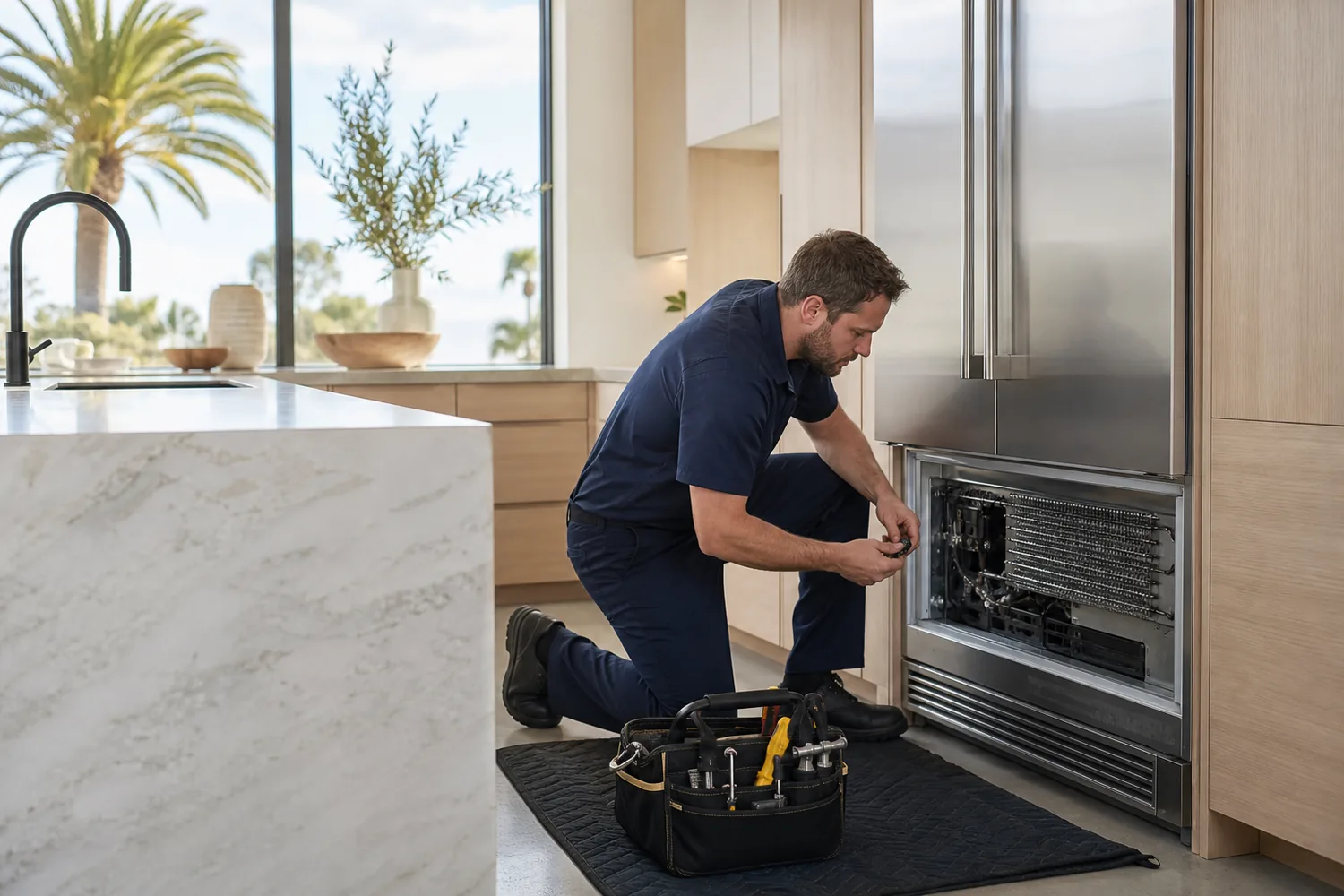
What actually breaks appliances in National City.
The brand badge tells us less than the water, the air and the age of the house. This is what our technicians look for first.
Salt corrosion
National City has bay frontage, so salt carried off the bay corrodes condenser coils, control board contacts and metal fasteners years earlier than a few miles inland. It is milder than the open coast but relentless. Age compounds exposure. Around 69.7 percent of homes here predate 1980, so a lot of the appliances we see have been breathing salt air for decades and the corrosion is cumulative.
A coastal refrigerator that is not cooling gets its condenser and board contacts inspected first, because that is usually where the fault is.
Prewar and postwar stock
The median National City home dates to 1969, and 70 percent of the housing predates 1980. Kitchens of that era were built around appliances that are no longer standard sizes, on circuits that were never meant to carry a modern oven or a heat pump dryer.
The symptom is rarely a dead appliance. It is an intermittent one that trips under load, or a replacement that fouls the cabinet face.
Where we work in National City.
National City is a city of about 58,460 people in San Diego County. Dispatch covers 2 delivery ZIP codes here, and the technician who comes out works San Diego County every day. One technician group covers all of National City; the ZIP codes below are the delivery areas we serve.
Not sure if we reach you?
Tell us the cross street. We will tell you the time window in about ten seconds.
Every major appliance, freestanding or built in.
Refrigerator & freezer
Not cooling, leaking, loud compressor, warm freezer. Coastal units get the condenser checked first.
Washer
Will not spin, will not drain, leaking or walking. Front load, top load and stacked.
Dryer
No heat, endless cycles, thermal shutdown. Half the calls in older stock are the vent run, not the dryer.
Dishwasher
Not draining, not cleaning, leaking, stuck mid cycle. Panel-ready and integrated units included.
Oven, range & cooktop
Burners that will not light, uneven baking, dead board. Gas, electric, induction and dual fuel.
Ice maker
No ice, slow ice, small hollow cubes, flooded bin. Under counter and built-in units too.
Microwave & disposal
Built-in, drawer and over-range microwaves, jammed disposals, vent hoods and warming drawers.
SPECIALISTBuilt-in & luxury
Sub-Zero, Viking, Thermador, Wolf, Miele and Dacor. Assigned to a technician who has worked the platform.
What National City repairs actually cost.
Nobody else on this search result will show you a number before you call. Here is the honest range, and what moves it.
| Typical National City job | What usually causes it | Typical range |
|---|---|---|
| Dishwasher not draining or not cleaning | A blocked sump, a tired drain pump or a failed inlet valve | $150 to $400 |
| Ice maker not producing | A failed fill valve, a frozen fill tube or a worn module | $150 to $380 |
| Refrigerator not cooling | Condenser fan, defrost system, or a coastal board contact | $180 to $480 |
| Dryer runs but will not heat | Element or thermal fuse, and very often a blocked vent run | $140 to $380 |
| Washer will not drain | Drain pump, filter obstruction or the hose | $160 to $450 |
| Oven not heating evenly | Igniter, bake element or a calibration drift | $160 to $480 |
| Built-in refrigerator sealed system | Refrigerant charge, compressor or evaporator on a built-in | $800 to $2,200 |
One flat diagnostic fee of $89 gets a licensed technician to your door. The full repair is quoted before any work starts, you approve it first, and the diagnostic fee goes toward the job when you book the repair.
What people here ask us first.
Salt air, and it is the reason coastal work is genuinely different work. National City has bay frontage, so salt carried off the bay corrodes condenser coils, control board contacts and metal fasteners years earlier than it does a few miles inland. It is milder than the open coast but relentless. Garage laundry rooms and utility spaces with a breeze running through them are the worst case we see. Age compounds exposure. Around 69.7 percent of homes here predate 1980, so a lot of the appliances we see have been breathing salt air for decades and the corrosion is cumulative. Two things shape how fast it bites here: the local climate runs mild marine, low swing, and about 41.2 percent of homes are detached, which is where the garage and side-yard installations are. So the order of the diagnostic changes. A refrigerator that is not cooling here gets its condenser and its board contacts inspected first, because that is where the fault usually is. The same symptom inland points somewhere else entirely. The tell-tale is a fridge that runs constantly with a condenser fan you can hear from the next room.
Fit and power, before anything mechanical. The median National City home dates to 1969, and 70 percent of the housing stock predates 1980, so a lot of kitchens here were built around appliances that are no longer standard sizes. A replacement that is nominally the same width can still foul the cabinet face, the counter overhang or the door swing. Older circuits are the other half of it. A kitchen wired for the appliances of that era often cannot carry what a modern oven or a heat pump dryer wants, and the symptom is not a dead appliance but an intermittent one that trips under load. Parts availability matters too, since a discontinued board on a well-built older unit can be the difference between a sensible repair and a replacement. We check the opening and the circuit before quoting, because finding out afterwards is how a repair turns into a remodel. It matters more here because about 41.2 percent of homes here are detached single family.
Most cooktops reach their expected life or fall short of it because of how they are treated, and the maintenance is simple. On gas: keep the burner ports clear, seat the caps properly after cleaning, and keep the igniters dry, since a boil-over into the igniter is the most common cause of a burner that clicks and will not light. On electric coil: do not let a warped or damaged element stay in service, because it burns the receptacle it plugs into, which is a bigger repair. On radiant glass and induction: lift cookware rather than sliding it, keep heavy cast iron off the edges, wipe spills before they run into the control area, and keep the ventilation under an induction cooktop clear so the electronics stay cool.
Done, a gas cooktop runs fifteen to twenty years, coil and radiant thirteen to fifteen, and induction ten to fifteen. Neglected, any of them can lose years, and the losses are usually the expensive kind: a cracked glass, a corroded control panel, an overheated board.
When a part does fail, the routine ones are worth replacing on a cooktop of any age. Our diagnostic visit is a flat $89, credited to the repair when you go ahead, and the technician will tell you honestly whether a fault is routine or the end.
We also cover the rest of San Diego County.
Appliance down in National City?
One call reaches a licensed technician near you. Same-day slots go fast.