Appliance Repair in Rialto, CA
The water in Rialto is hard, and scale is behind more of the repairs we do here than any single part. Our technicians check fill volume and water pressure before anyone condemns a board, because in this city the board is rarely the problem.
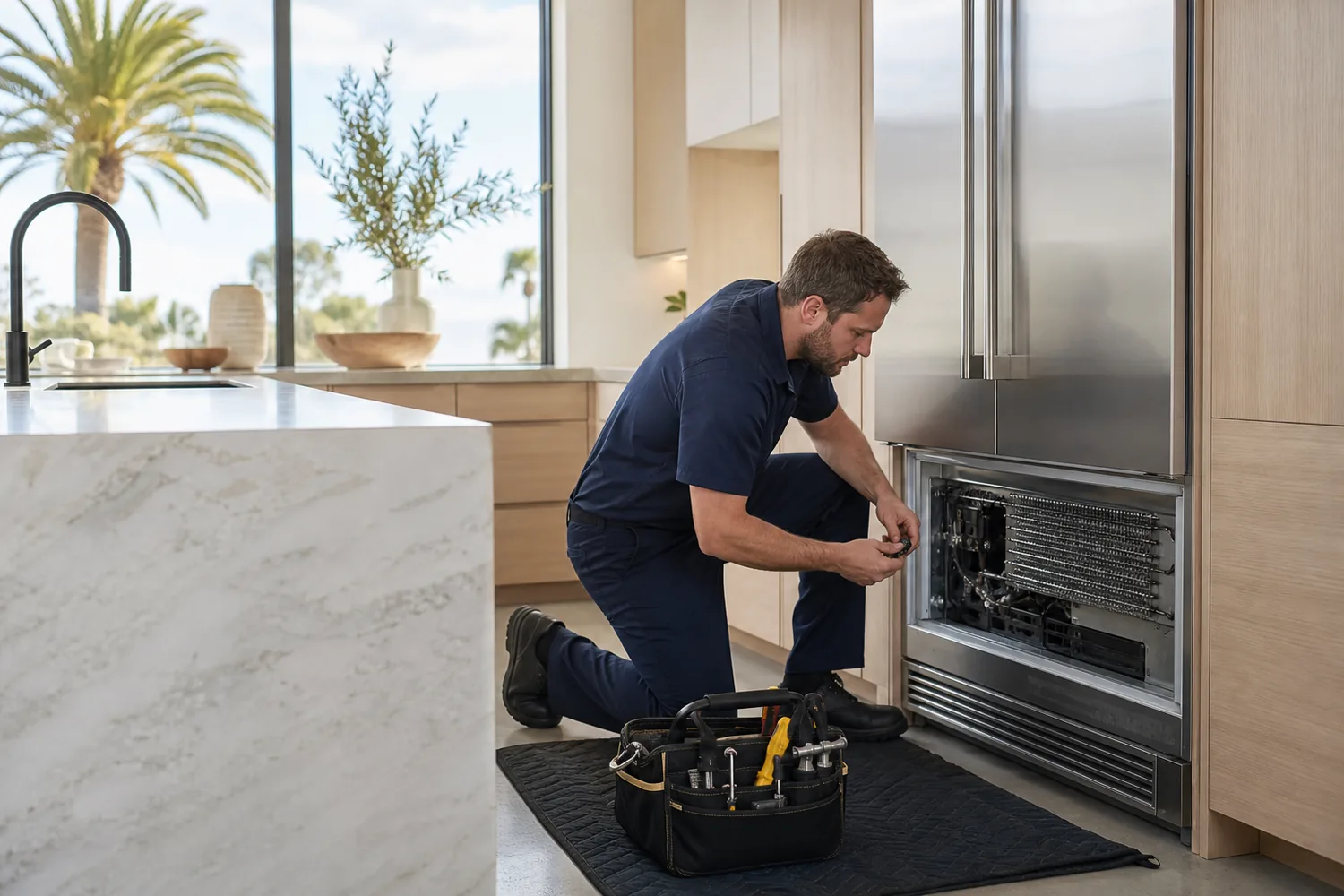
All of Rialto, covered.
Rialto is a city of about 104,918 people in San Bernardino County. Around 68.0 percent of homes are detached houses and the median home was built in 1982, so most of what we see is a full-size kitchen and a garage or side-yard laundry. Dispatch covers 2 delivery ZIP codes here, and the technician who comes out works Inland Empire every day. Every delivery ZIP code in Rialto is covered by the same number and the same team.
Not sure if we reach you?
Tell us the cross street. We will tell you the time window in about ten seconds.
Every major appliance, freestanding or built in.
Refrigerator & freezer
Not cooling, leaking, loud compressor, warm freezer. Freestanding, counter depth and built-in columns.
Washer
Will not spin, will not drain, leaking or walking. Hard water takes out the seals early here.
Dryer
No heat, endless cycles, thermal shutdown. Gas and electric, plus the vent run that causes half the calls.
Dishwasher
Not draining, not cleaning, leaking, stuck mid cycle. The number one hard-water casualty in the city.
Oven, range & cooktop
Burners that will not light, uneven baking, dead board. Gas, electric, induction and dual fuel.
Ice maker
No ice, slow ice, small hollow cubes, flooded bin. Almost always scale on the fill valve here.
Microwave & disposal
Built-in, drawer and over-range microwaves, jammed disposals, vent hoods and warming drawers.
SPECIALISTBuilt-in & luxury
Sub-Zero, Viking, Thermador, Wolf, Miele and Dacor. Assigned to a technician who has worked the platform.
What Rialto repairs actually cost.
Nobody else on this search result will show you a number before you call. Here is the honest range, and what moves it.
| Typical Rialto job | What usually causes it | Typical range |
|---|---|---|
| Dishwasher not draining or not cleaning | Scale on the inlet valve, a blocked sump or a tired drain pump | $150 to $400 |
| Ice maker not producing | Fill valve scaled shut, or a frozen fill tube | $150 to $380 |
| Refrigerator not cooling | Condenser fan, defrost system or a start relay | $180 to $480 |
| Dryer runs but will not heat | Element, thermal fuse or igniter | $140 to $380 |
| Washer will not drain | Drain pump, filter obstruction or the hose | $160 to $450 |
| Oven not heating evenly | Igniter, bake element or a calibration drift | $160 to $480 |
| Built-in refrigerator sealed system | Refrigerant charge, compressor or evaporator on a built-in | $800 to $2,200 |
One flat diagnostic fee of $89 gets a licensed technician to your door. The full repair is quoted before any work starts, you approve it first, and the diagnostic fee goes toward the job when you book the repair.
What people here ask us first.
Rialto runs hard water, and scale builds on whatever meets the water first. In a dishwasher that is the inlet valve, the spray arms and the heating element. In an ice maker it is the fill tube and the water valve. Scale narrows the opening water has to pass through, so the machine fills slowly or unevenly and the symptoms start looking electrical long before anything electrical has failed. Hardness is also far from uniform here. The city does not draw everything from one place, and readings run from around 2 grains in some parts of town to about 13 in others. Two homes a few miles apart can genuinely be on different water and scale up at different rates, which is why a neighbor's experience with the same model is not a reliable guide to yours. Age of the plumbing compounds it. About 45 percent of homes here predate 1980, and older supply lines and shutoffs hold scale that keeps feeding an appliance after the appliance itself has been cleaned up. What that means for the repair is that we check water pressure and fill volume before replacing anything. Swapping a control board on a scaled machine fixes nothing and costs a great deal more. The tell-tale is a dishwasher that stopped cleaning well long before it stopped running, or an ice maker turning out small, hollow cubes.
Two California factors sit behind the average, one in the parts and one in the labor. The parts factor is hard water. In much of the state the water inlet valve is the most replaced washer part, because its screen and its internals scale until the machine fills slowly or throws a fill error, and the same minerals grind at the pump seal and the door seal. Those are low-end repairs when they are diagnosed as scale and expensive ones when a board is blamed for a slow fill. The labor factor is where the washer lives. A machine stacked under a dryer in a hallway closet, or sitting on a pedestal in a tight alcove, takes real time to reach: the dryer comes off, the pedestal comes apart, the machine comes out. A flat labor charge per job code absorbs most of that, which is one reason we do not bill by the hour, but an installation that fights the technician is worth mentioning when you book so the visit is scheduled with room.
Across everything, completed washer repairs typically run $160 to $450, parts and labor, with the front-load bearing job the exception above the range.
The diagnostic visit runs a flat $89; the technician checks water pressure and the valve screens before condemning anything electronic, quotes the complete repair in writing, and that fee is credited to the repair when you go ahead.
On a modern washer the common repair often begins with an error code, and the code is a starting point rather than a diagnosis. Drain codes point at the pump, the filter or a kinked hose, and the pump filter behind the small door at the bottom front is worth checking before calling. Door or lid codes point at the lock, the latch or the strike, or at a door that has warped enough not to press the switch. Unbalanced-load codes point at the suspension, a small load that cannot balance, or a machine that is not level. Fill codes point at the inlet valve, the pressure switch and its hose, or a supply tap that is not fully open. Motor codes point at the motor, its control, or, on direct-drive machines, the sensor that reads the rotor position. Communication codes point at a connection between the boards, often a corroded or loosened connector rather than a failed board.
What the codes rarely mean is that the main control board has failed. The board is the part most often replaced on the strength of a code and the part least often at fault. Behind most codes is a sensor, a switch, a pump or a connection costing a fraction of the board.
Note the code before you clear it; it saves the technician time. Our diagnostic visit is $89, flat, credited to the repair when you go ahead, and the technician tests the part the code points to rather than replacing the board that reported it.
We also cover the rest of San Bernardino County.
Appliance down in Rialto?
One call reaches a licensed technician near you. Same-day slots go fast.