Appliance Repair in Tarzana, CA
Tarzana kitchens carry more built-in and panel-ready appliances than most of the state, and those do not fail the way a freestanding unit fails. We send a technician who has worked the platform, with the price in writing before any work.
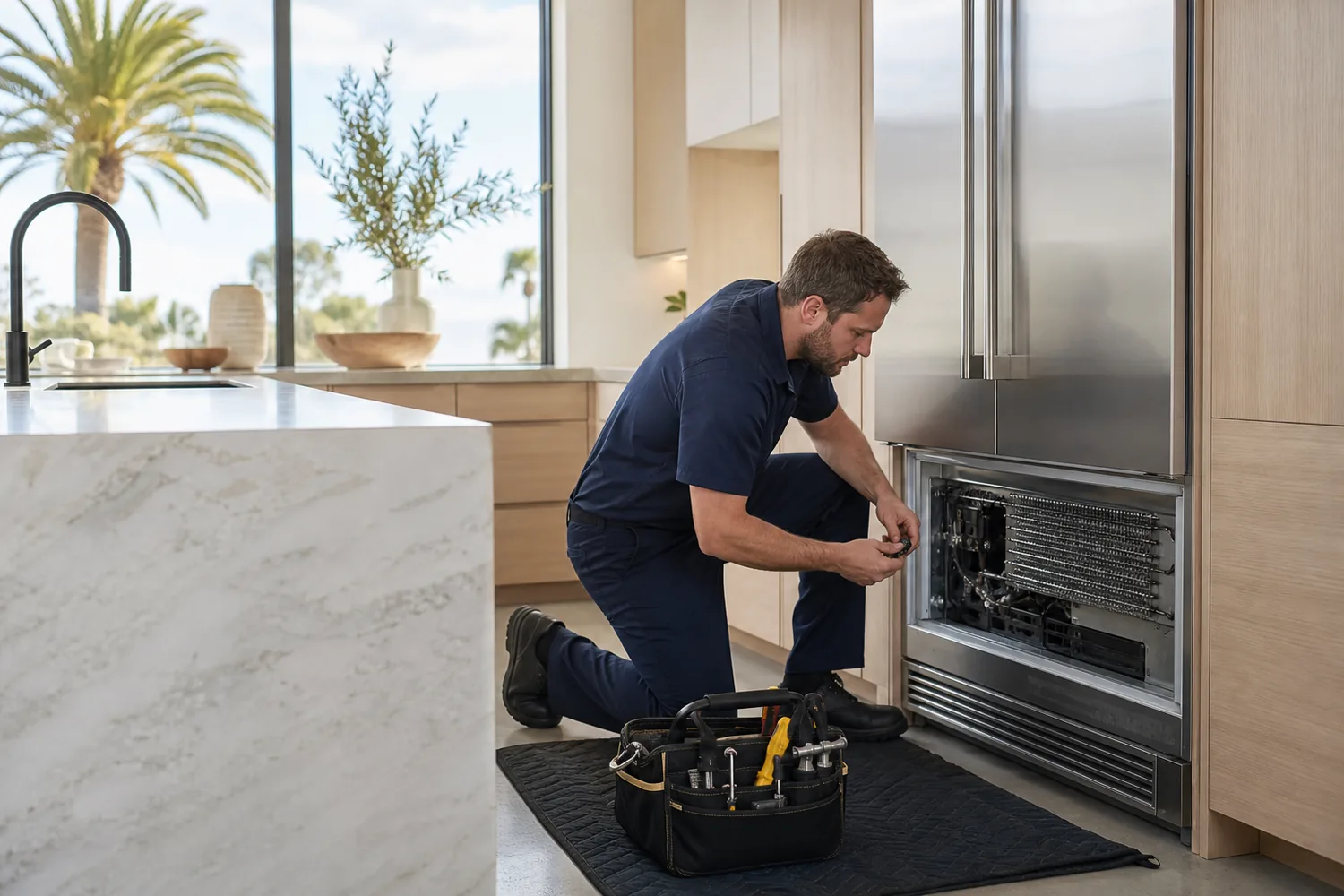
Tarzana is hard on appliances. Here is why.
Most repair companies replace the failed part and leave. Here, that part fails again unless somebody deals with what killed it.
Built-in and panel-ready
Tarzana carries more built-in and panel-ready appliances than most of the state, and they fail differently. The stock here is mixed, around 46.7 percent detached houses and the rest attached or multi-unit, so we see both full-height built-ins and the narrower integrated units that fit a condo kitchen. The median home here dates to 1973.
These jobs go to a technician who has worked the platform, with the factory service literature open.
Older kitchens
The median Tarzana home dates to 1973, and 78 percent of the housing predates 1980. Kitchens of that era were built around appliances that are no longer standard sizes, on circuits that were never meant to carry a modern oven or a heat pump dryer.
Long dryer vent runs through attics and side walls cause half the dryer calls in this kind of stock.
All of Tarzana, covered.
Tarzana is part of Los Angeles, and it gets its own dispatch because the housing and the appliances in it are their own story. We run Los Angeles County as one dispatch area, and Tarzana sits inside it with 2 delivery ZIP codes. Every delivery ZIP code in Tarzana is covered by the same number and the same team.
Not sure if we reach you?
Tell us the cross street. We will tell you the time window in about ten seconds.
Every major appliance, freestanding or built in.
Refrigerator & freezer
Not cooling, leaking, loud compressor, warm freezer. Freestanding, counter depth and built-in columns.
Washer
Will not spin, will not drain, leaking or walking. Front load, top load and stacked.
Dryer
No heat, endless cycles, thermal shutdown. Half the calls in older stock are the vent run, not the dryer.
Dishwasher
Not draining, not cleaning, leaking, stuck mid cycle. Panel-ready and integrated units included.
Oven, range & cooktop
Burners that will not light, uneven baking, dead board. Gas, electric, induction and dual fuel.
Ice maker
No ice, slow ice, small hollow cubes, flooded bin. Under counter and built-in units too.
Microwave & disposal
Built-in, drawer and over-range microwaves, jammed disposals, vent hoods and warming drawers.
SPECIALISTBuilt-in & luxury
Sub-Zero, Viking, Thermador, Wolf, Miele and Dacor. Dense in this part of the county.
What Tarzana repairs actually cost.
Nobody else on this search result will show you a number before you call. Here is the honest range, and what moves it.
| Typical Tarzana job | What usually causes it | Typical range |
|---|---|---|
| Dishwasher not draining or not cleaning | A blocked sump, a tired drain pump or a failed inlet valve | $150 to $400 |
| Ice maker not producing | A failed fill valve, a frozen fill tube or a worn module | $150 to $380 |
| Refrigerator not cooling | Condenser fan, defrost system or a start relay | $180 to $480 |
| Dryer runs but will not heat | Element or thermal fuse, and very often a blocked vent run | $140 to $380 |
| Washer will not drain | Drain pump, filter obstruction or the hose | $160 to $450 |
| Oven not heating evenly | Igniter, bake element or a calibration drift | $160 to $480 |
| Built-in refrigerator sealed system, panel-ready columns | Refrigerant charge, compressor or evaporator on a built-in | $800 to $2,200 |
One flat diagnostic fee of $89 gets a licensed technician to your door. The full repair is quoted before any work starts, you approve it first, and the diagnostic fee goes toward the job when you book the repair.
What people here ask us first.
Fit and power, before anything mechanical. The median Tarzana home dates to 1973, and 78 percent of the housing stock predates 1980, so a lot of kitchens here were built around appliances that are no longer standard sizes. A replacement that is nominally the same width can still foul the cabinet face, the counter overhang or the door swing. Older circuits are the other half of it. A kitchen wired for the appliances of that era often cannot carry what a modern oven or a heat pump dryer wants, and the symptom is not a dead appliance but an intermittent one that trips under load. Parts availability matters too, since a discontinued board on a well-built older unit can be the difference between a sensible repair and a replacement. We check the opening and the circuit before quoting, because finding out afterwards is how a repair turns into a remodel. It matters more here because about 46.7 percent of homes here are detached single family.
Usually yes, and more often than people expect. Tarzana has the kind of housing that carries built-in and panel-ready appliances, Sub-Zero, Viking, Thermador, Wolf, Miele and Dacor, and the economics on those are different from a freestanding unit. The cabinetry was built around the appliance, so replacing one means a carpenter as well as an appliance, and that changes the arithmetic on almost every repair. The work is different too. A sealed-system refrigerator gets pressure readings taken before anything is replaced, because the difference between a failed evaporator fan and a failing compressor is not visible from the outside and guessing at it is expensive. A panel-ready door gets realigned after the repair, since it carries the weight of your cabinetry and a door sitting slightly proud stops sealing. The complication here is usually the cabinetry rather than the appliance. In older kitchens the surround was built to the dimensions of the original unit, and those are frequently not current dimensions, so a replacement means carpentry and a repair does not. That gap is what makes repair the sensible call far more often than people assume. Worth saying plainly: not every built-in is worth saving. A compressor failure on an older unit can cost more than the machine is worth, and we would rather tell you that on the visit than quote you a repair you should not buy. The stock here is mixed, around 46.7 percent detached houses and the rest attached or multi-unit, so we see both full-height built-ins and the narrower integrated units that fit a condo kitchen. The median home here dates to 1973.
An ice maker rarely dies of one thing; it wears in a sequence, and knowing the sequence tells you where yours is. First the water supply: the inlet valve and the fill tube scale up, and the ice gets smaller, then hollow, then stops. That is the supply, not the ice maker, and it is the cheapest fix. Second the fill tube freezes, because slow water freezes on the way in; clearing it and fixing the flow solves it. Third the module itself: the ejector arm or the gear that turns it wears, the mold heater that releases the cubes fails, or the motor stops cycling. That is a module replacement, moderate and routine. Fourth, on under-counter machines, the water pump and the harvest components wear and the evaporator plate scales. Last, on any ice-making appliance with its own compressor, the sealed system.
Three to eight years for a refrigerator module and eight to twelve for an under-counter machine are the usual figures, and where an ice maker lands in that range depends on whether the first two stages were caught early or left until they wore out the third.
Our diagnostic visit is a flat $89, credited to the repair when you go ahead, and the technician checks the valve and the tube before quoting a module.
We also cover the rest of Los Angeles County.
Appliance down in Tarzana?
One call reaches a licensed technician near you. Same-day slots go fast.