Appliance Repair in West Sacramento, CA
West Sacramento has a lot of newer, all-electric homes, and induction and heat pump appliances are routinely misdiagnosed by technicians who learned on gas. We diagnose them correctly, and quote before any work.
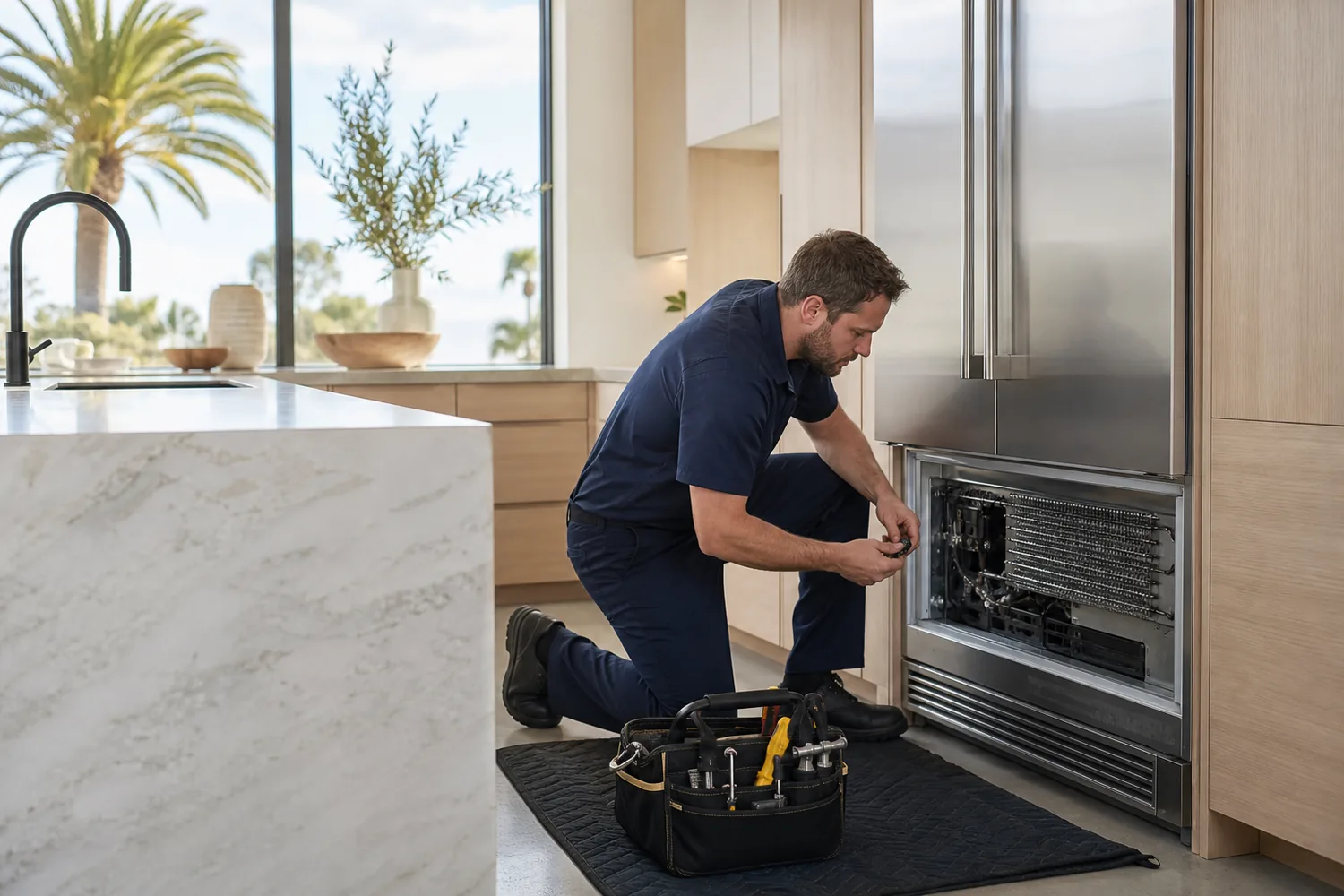
Where we work in West Sacramento.
West Sacramento is a city of about 55,991 people in Yolo County. Around 63.9 percent of homes are detached houses and the median home was built in 1987, so most of what we see is a full-size kitchen and a garage or side-yard laundry. We run Sacramento Region as one dispatch area, and West Sacramento sits inside it with 4 delivery ZIP codes. One technician group covers all of West Sacramento; the ZIP codes below are the delivery areas we serve.
Not sure if we reach you?
Tell us the cross street. We will tell you the time window in about ten seconds.
Every major appliance, freestanding or built in.
Refrigerator & freezer
Not cooling, leaking, loud compressor, warm freezer. Freestanding, counter depth and built-in columns.
Washer
Will not spin, will not drain, leaking or walking. Front load, top load and stacked.
Dryer
No heat, endless cycles, thermal shutdown. Heat pump models fail differently and we know how.
Dishwasher
Not draining, not cleaning, leaking, stuck mid cycle. Panel-ready and integrated units included.
Oven, range & cooktop
Burners that will not light, uneven baking, dead board. Gas, electric, induction and dual fuel.
Ice maker
No ice, slow ice, small hollow cubes, flooded bin. Under counter and built-in units too.
Microwave & disposal
Built-in, drawer and over-range microwaves, jammed disposals, vent hoods and warming drawers.
SPECIALISTBuilt-in & luxury
Sub-Zero, Viking, Thermador, Wolf, Miele and Dacor. Assigned to a technician who has worked the platform.
What West Sacramento repairs actually cost.
Nobody else on this search result will show you a number before you call. Here is the honest range, and what moves it.
| Typical West Sacramento job | What usually causes it | Typical range |
|---|---|---|
| Dishwasher not draining or not cleaning | A blocked sump, a tired drain pump or a failed inlet valve | $150 to $400 |
| Ice maker not producing | A failed fill valve, a frozen fill tube or a worn module | $150 to $380 |
| Refrigerator not cooling | Condenser fan, defrost system or a start relay | $180 to $480 |
| Dryer runs but will not heat | Element, thermal fuse or igniter | $140 to $380 |
| Washer will not drain | Drain pump, filter obstruction or the hose | $160 to $450 |
| Oven not heating evenly | Igniter, bake element or a calibration drift | $160 to $480 |
| Built-in refrigerator sealed system | Refrigerant charge, compressor or evaporator on a built-in | $800 to $2,200 |
One flat diagnostic fee of $89 gets a licensed technician to your door. The full repair is quoted before any work starts, you approve it first, and the diagnostic fee goes toward the job when you book the repair.
What people here ask us first.
Yes, and they are worth getting to someone who has actually worked on them. 12 percent of West Sacramento housing was built in 2010 or later, which in California means a lot of all-electric kitchens where the previous generation had gas. Induction and heat pump appliances fail differently and get misdiagnosed by technicians who learned on gas. An induction cooktop that cuts out under load is usually a coil or a cooling fan, not the glass, and replacing the surface on that fault is an expensive way to fix nothing. A heat pump dryer that takes forever is usually a blocked evaporator rather than a heating element, because it does not have one. The tell-tale on the dryer is that it never gets hot to the touch but still dries, slowly. That is normal for a heat pump, right up until it is not. For context on what is going in locally, about 63.9 percent of homes here are detached single family.
There is no running-cost argument for replacing a seven-year-old refrigerator, and it is worth saying because the argument gets applied to refrigerators of every age. The large efficiency gains in refrigerators happened between the early 1990s and the early 2000s, when a new unit could use half the electricity of the one it replaced. Since then the gains have been incremental. A seven-year-old refrigerator uses close to what a new one of the same size and style uses, so the utility bill will not pay for the replacement, and the decision comes down to the repair alone.
On that basis the case for repairing at seven is strong. The refrigerator is mid-life. The common faults at this age, fans, relays, defrost parts, gaskets, valves, ice makers, are inexpensive. Even a control board is a fraction of a new unit. The only repair that can compete with replacement is a compressor or a refrigerant leak on a basic freestanding model, and even that is often worth doing if the manufacturer's parts-only coverage still applies.
Where the running-cost argument does apply is a refrigerator from before the mid 2000s facing a large repair. Yours is not that. Our diagnostic visit is a flat $89, applied to the repair when you go ahead, and the full repair is quoted in writing first.
On a frost-free upright, the fix is very often in the defrost system, and it helps to know how that system fails. Every several hours the freezer stops cooling and switches on a heater under the evaporator to melt the frost that has built on it; a defrost thermostat clamped to the coil tells the control when the ice is gone, and the meltwater runs down a drain to a pan by the compressor. When the heater burns out, the frost is never melted, and over two or three weeks it grows into a block of ice that covers the coil and blocks the airflow. The symptom is a freezer that slowly loses its cold, holds better after a full manual thaw, then fails again a few weeks later. When the defrost thermostat fails, the heater either never runs or runs too long. When the drain freezes or clogs, the meltwater refreezes as a sheet of ice on the freezer floor or drips into the compartment below.
The repair is the failed part, and none of them is expensive: a heater, a thermostat, a timer or control, or a drain cleared and its heater checked. The technician tests each for continuity rather than guessing, because they produce similar symptoms.
If the back wall is a sheet of frost and the fan is running, that is the diagnosis to expect. The diagnostic visit is $89, credited to the repair when you go ahead.
The downside depends on who is doing the laundry, and for some households a vented dryer is the better machine. A large family running three or four loads a day needs a dryer that turns loads over quickly; a heat pump dryer's long cycle becomes a bottleneck, and the laundry backs up. A house with heavy loads, sports kit, work clothes, towels for a full household, pet bedding, wants the high heat a vented dryer gives, both for speed and for the sanitizing effect that heat pump drying does not provide. A household that lines up loads in the evening and needs them dry by morning has less patience for a machine that treats each load gently. And a laundry room in a hot garage or a cold outbuilding puts the heat pump outside its comfortable working range and slows it further.
Where a heat pump dryer suits: a small household, a condo or apartment with no vent path, a laundry closet in the middle of the home, anyone whose electricity bill matters more than their cycle time, and anyone tired of a vent to clean.
If you already own one and it has become slower than it was, that is a fault rather than a feature, and usually a cheap one: a clogged exchanger or secondary filter, a sensor, a pump. Our diagnostic visit is $89, credited to the repair when you go ahead, and heat pump dryers go to technicians who service them regularly.
We also cover the rest of Sacramento Region.
Appliance down in West Sacramento?
One call reaches a licensed technician near you. Same-day slots go fast.